Meteors
How to Photograph a Meteor Shower (Settings + 2026–27 Dates)
Meteor photography is mostly about taking a lot of frames. A good shower produces one bright meteor every few minutes somewhere in the sky, and your lens sees only part of that sky for twenty seconds at a time. So you point a wide, fast lens at the right part of the sky, shoot continuously for hours, and pick out the frames with streaks in them the next morning. That is how to photograph a meteor shower. This guide covers the settings, where to aim, how to run the sequence, and the shower calendar through 2027 with the state of the Moon for each peak.
At a glance
- Settings: f/2.8 or faster, ISO 1600–3200, 15–25 s (from the NPF rule), manual focus on a star, RAW, an intervalometer set to shoot continuously with a 1-second gap.
- Aim 30–60° away from the radiant, not at it. Meteors near the radiant are short, and farther away they leave longer streaks.
- When: after midnight until dawn, when your side of Earth faces into the meteor stream and the radiant is high.
- Best upcoming: the Geminids on Dec 13–14, 2026 (120+ per hour, Moon sets early) and the Quadrantids on Jan 3–4, 2027 (dark Moon).
What a meteor shower actually is
A meteor shower happens when Earth crosses the debris trail of a comet (or, for the Geminids, an asteroid). Particles the size of sand grains hit the atmosphere at 19–43 miles per second and glow for a fraction of a second at 50–60 miles up. Because they all travel in parallel, perspective makes them appear to radiate from one point in the sky. That point is the radiant, and the shower is named for the constellation it sits in. A shower's strength is quoted as a ZHR, the zenithal hourly rate, which is what one observer would count under a perfect dark sky with the radiant overhead. Real counts are lower, often half.


Meteor shower dates 2026–2027, and the Moon on each night
Rates vary by source and by year. Look at the Moon column first, because the Moon decides whether a night is worth the drive.
| Shower | Peak night | Rate (ZHR) | Moon | Verdict |
|---|---|---|---|---|
| Draconids | Oct 8–9, 2026 | ~10, evening shower | Thin crescent | Good, if it flares |
| Orionids | Oct 21–22, 2026 | ~20 | Waxing gibbous | Fair. Moon sets after midnight |
| Taurids (S & N) | Nov 5 & Nov 12, 2026 | ~5, slow fireballs | Dark | Fireball chances |
| Leonids | Nov 17–18, 2026 | 10–15 | First quarter | Fair after moonset |
| Geminids | Dec 13–14, 2026 | 120–150 | Waxing crescent, sets mid-evening | Best of the year |
| Ursids | Dec 22–23, 2026 | ~10 | Bright gibbous | Poor |
| Quadrantids | Jan 3–4, 2027 | 80–110, sharp 6-hour peak | Dark | Excellent, if the peak falls during your night |
| Lyrids | Apr 22–23, 2027 | ~18 | Bright | Poor |
| Eta Aquariids | May 5–6, 2027 | 50–60 (southern hemisphere best) | New Moon | Excellent pre-dawn |
| Delta Aquariids | Jul 30–31, 2027 | ~25 | Dark | Good |
| Perseids | Aug 12–13, 2027 | ~100 | Waxing gibbous (~83%) until ~1:30 am | Fair. Shoot after moonset |
| Orionids | Oct 21–22, 2027 | ~20 | — | Fair |
| Leonids | Nov 17–18, 2027 | 10–15 | Bright | Poor |
| Geminids | Dec 13–14, 2027 | 120–150 | Bright | Poor. Plan for the 2026 Geminids instead |
| Ursids | Dec 22–23, 2027 | ~10 | Dark | Fair |
Still Dark lists every peak in Sky Events → Meteors with the time the radiant rises at your location, the Moon's illumination that night and a plain verdict ("dark skies — great year"). Set a reminder from the row.
Best time to photograph a meteor shower: after midnight, radiant up, Moon down
Before midnight you're on the trailing side of Earth and meteors have to catch up with you. After midnight you're on the leading side and they hit head-on, so they're brighter and there are more of them, and rates climb until dawn. The radiant matters too. The higher it is, the more of the shower is above your horizon. For most northern showers that means shooting from 1 am until the first light of astronomical dawn. It's the coldest part of the night, so dress for it and bring the chair.
The peak is a night, but showers run for days or weeks either side at reduced rates. If the peak night is cloudy or moonlit, the night before or after is often still worth shooting. The Perseids in particular stay active for a week.
Where to aim the camera during a meteor shower
It seems natural to point at the radiant, but don't. Meteors close to the radiant come almost straight at you and show up as short dots. Those 30–60° away cross the sky sideways and leave long streaks. Aim so the radiant sits just outside one edge of the frame, or put it a third of the way in so the meteors spread across the rest.
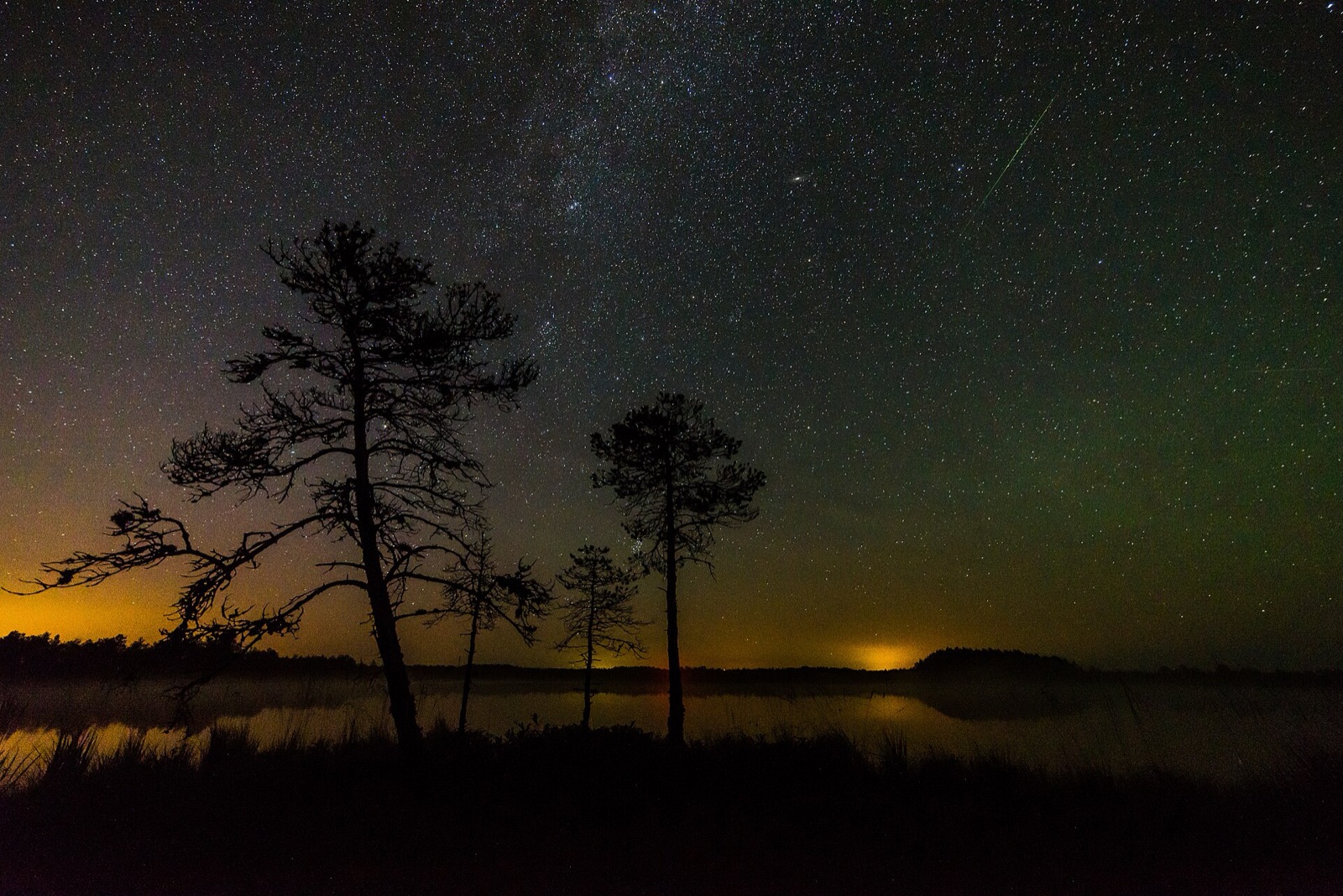

Lens choice is a trade-off. A wide lens sees more sky and catches more meteors, but makes each one smaller. 14–24 mm on full frame (10–16 mm on crop) is the usual range. Go wider than that and even a spectacular fireball comes out as a faint scratch. Include a foreground (a ridge, trees, a tent, the Milky Way) so the picture is a landscape with meteors in it and not just lines on a black background.
What gear you need for a night of meteors
The camera runs by itself for four hours. Most of this list is about keeping it running.
- A fast wide lens (f/2.8 or faster) and a body you can leave unattended.
- An intervalometer, built in on most modern cameras, otherwise a cheap cable version, set to continuous shooting.
- Power for four hours or more: spare batteries, a USB power bank if your camera charges in use, or a dummy battery.
- Two large memory cards. Twenty-second frames for four hours is around 700 RAW files, 20–35 GB.
- A dew heater. Fog on the front element is a common way to lose the second half of the night.
- A reclining chair, a warm bag and a red headlamp. You'll be watching the sky, not the camera.
How to photograph a meteor shower: camera settings
- Manual mode, RAW, long-exposure noise reduction off (it would halve your capture time), stabilisation off.
- Aperture wide open. Meteors are fast and faint, so every stop counts.
- ISO 1600–3200, up to 6400 under a very dark sky. Higher ISO records fainter meteors. It also adds noise, which you can deal with later.
- Shutter from the NPF rule: for a 20 mm f/2.8 lens on a 24-megapixel full-frame body, about 18–20 s. The old 500 rule says 25 s (NASA's rule of thumb). Shorter exposures mean more frames and less background glow per frame, and longer ones mean fewer files. Both catch the same meteors, because how bright a meteor comes out doesn't depend on the shutter speed. Our 500 rule vs NPF rule guide goes deeper on the two rules.
- Manual focus on a bright star, checked at 100% magnification, then taped. See focusing at night if the star won't come to a point.
- White balance fixed around 3800–4200 K for a consistent sequence.
- Intervalometer: continuous, with a 1-second gap. While the shutter is closed, a fireball can cross the frame and you won't record it.
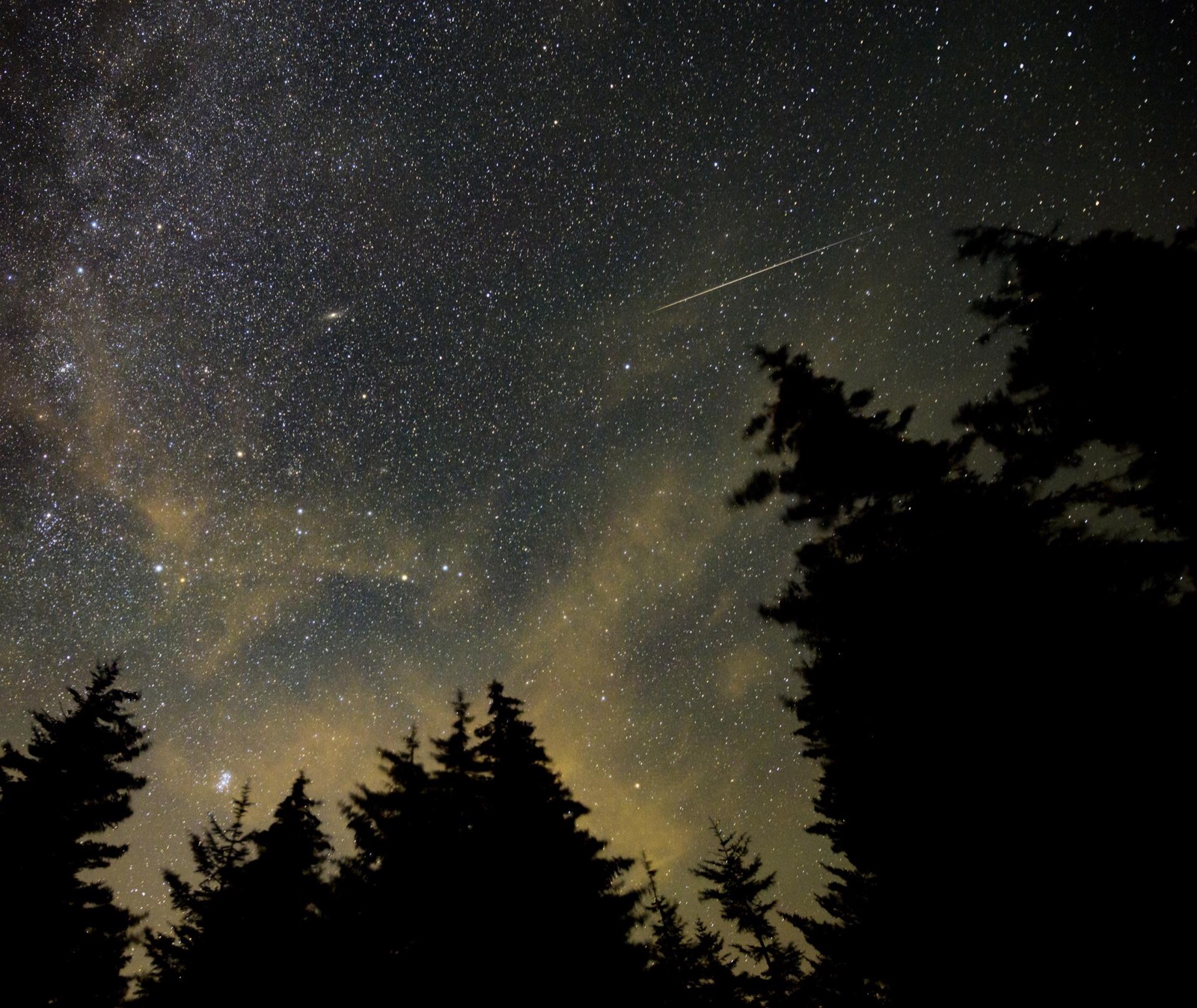
Running the sequence
- Set up before astronomical darkness. Focus and frame while there's still a little light.
- Start the sequence and leave it. Don't touch the tripod. Check focus and lens fog every half hour.
- Swap batteries and cards between frames, not during, and note the time so you can rebuild the sequence later.
- Watch the sky. When you see a big one, note the frame number so you can find it in the morning without going through the whole night's files.
A bonus target: persistent trains
Bright meteors sometimes leave a glowing trail that drifts and twists for seconds to minutes. With a second camera and a 135–200 mm lens at ISO 6400 aimed at a rich part of the sky, shooting 5–10 second frames, you can occasionally catch one. It makes an unusual sequence, but catching one is mostly luck.
Meteor shower composites
The famous "hundreds of meteors" images are composites, with every meteor from a night stacked onto one frame. It's fine to make one, as long as you do it accurately. Rotate each meteor frame so its stars align with the base frame (the sky turned between frames), so the meteors still point at the radiant. Free tools like StarStaX and Sequator handle the alignment. Then label the result a composite.
Common mistakes
- Pointing at the radiant. The meteors come out short.
- Shooting before midnight and going home just as the rates were about to climb.
- Autofocus, or focus checked once and then knocked.
- A long gap between frames. Set it to one second.
- No dew protection.
- Ignoring the Moon. Check the table and the app before you commit a night.
FAQ
What camera settings should I use for a meteor shower?
f/2.8 or faster, ISO 1600–3200, 15–25 seconds, manual focus on a star, RAW, continuous shooting with a 1-second gap. Aim 30–60° from the radiant.
How many meteors will I actually catch on camera?
On a good shower under dark skies with a 20 mm lens, expect a handful to a dozen usable meteors in a 3–4 hour sequence. Most frames will be empty, and that's normal.
Does a longer exposure catch more meteors?
No. A meteor lasts a fraction of a second and its brightness on the sensor doesn't depend on shutter speed. A longer exposure only adds sky glow around it. Keep frames at the NPF limit and shoot continuously.
Can I photograph a meteor shower with a phone?
Rarely. Phone night modes stack short exposures and tend to throw away the fast, faint streak. A manual-camera app with 15–30 second exposures on a tripod has a chance with bright fireballs.
Sources and further reading
- NASA Science — How to Photograph a Meteor Shower.
- Alex Conu, PhotographingSpace — How to Photograph Your First Meteor Shower (aiming, persistent trains).
- EarthSky — meteor shower guide; Space.com — meteor showers 2026; Asteroid Alerts — 2027 calendar. Rates and Moon phases compiled September 2026; check the app for the exact times at your location.