Planets
Why Venus Is the Brightest Planet, and How to See and Photograph It
People often report Venus as a UFO. You see it low in the west after sunset or low in the east before dawn, and nowhere else. It's far brighter than any star and it doesn't twinkle. At its brightest it reaches magnitude −4.9, which is enough to cast a faint shadow at a dark site and to be seen in a blue daytime sky. So why is Venus so bright, why is it always near the Sun in the sky, and why is it the evening star for some months and the morning star for others? This guide explains the physics, then how to find Venus in daylight and how to photograph it.
At a glance
- Settings: twilight scene, tripod, f/4, 1/30–2 s, ISO 100–400. Crescent through a scope or 600 mm and up, 1/250–1/1000 s, in twilight or daylight.
- When (as of September 2026): an evening object in the west, brightest on September 18, 2026 (magnitude −4.8). It's between Earth and the Sun on October 24 and back in the morning sky from mid-November.
- Where: always within 47° of the Sun, so low in the west after sunset or the east before sunrise. Never high at midnight.
- Daylight: easiest with the Moon beside it. Next on September 14, 2026, when the crescent Moon occults Venus in daylight for Europe, the Middle East and north-east Africa.
- Afterwards: single frames need little more than a curves adjustment. Telescope crescents are stacked from video.
Why is Venus so bright?
There are three reasons. Venus orbits at 0.72 AU, so each square foot of it gets about 1.9 times the sunlight Earth does (1/0.72² ≈ 1.9). It comes closer to Earth than any other planet, about 25 million miles at the October 2026 inferior conjunction, so its disk looks large. Most of all, it's completely covered in sulfuric-acid cloud that reflects most of the sunlight back into space. Its Bond albedo (the fraction of all incoming sunlight reflected) is about 0.76, and its geometric albedo is about 0.69. That means Venus reflects about three-quarters of the light that hits it. The Moon reflects about a tenth.
At its faintest, when it's small and nearly full on the far side of the Sun, Venus is about magnitude −3, which is still brighter than any star. At its brightest it reaches −4.9. Each magnitude step is a factor of about 2.5, so Venus at its peak is about 6 times brighter than Jupiter at its best and 23 times brighter than Sirius.
| Object | Apparent magnitude |
|---|---|
| Sun | −26.8 |
| Full Moon | −12.7 |
| Venus at its brightest | −4.9 |
| Jupiter at its brightest | −2.9 |
| Mars at a close opposition | −2.9 |
| Sirius, the brightest star | −1.5 |
Evening star, morning star: why Venus is only ever low in the west or the east
A common mistake goes like this: "Venus is bright because when you look west after sunset, the Sun is just below the horizon lighting it up." It sounds reasonable, but it's wrong. The Sun lights Venus all the time, whatever the hour is here. Venus is near the Sun in our sky because its orbit is inside Earth's. Seen from Earth, a planet on a smaller orbit can never get far from the Sun, so there is a maximum angle between them. For Venus that maximum, the greatest elongation, is about 47° (45°–47° from one apparition to the next). Mercury's is about 28°.
.jpg)
So Venus sets within about three hours after the Sun, or rises within about three hours before it. It's an evening object or a morning object. It's never both, and it's never up at midnight. When Venus is east of the Sun it sets after the Sun, and that's the "Evening Star" in the west. When it's west of the Sun it rises before the Sun, and that's the "Morning Star" in the east. It's the same planet in a different half of its cycle.
The cycle from one arrangement back to the same one, the synodic period, is about 584 days, roughly 19.5 months:
- Superior conjunction. Venus is on the far side of the Sun. It's small and full, and you can't see it in the glare.
- Evening apparition. Venus climbs into the western sky, reaching greatest eastern elongation about 220 days later, half-lit.
- Greatest brilliancy, about five weeks after elongation, as a fat crescent.
- Inferior conjunction. Venus passes between Earth and the Sun, as a very large, thin crescent that you can't see with the naked eye.
- Morning apparition, the same in reverse: greatest brilliancy five weeks after conjunction, greatest western elongation after ten, then a slow return to superior conjunction.
The Solar System card in Still Dark shows this from above. The 2D orbit map places Venus on its smaller orbit inside Earth's, and dragging the time machine through 2026–2027 shows it swinging from one side of the Sun to the other, which is why it can only be an evening or a morning object. Sky Events → Elongations lists the greatest elongation and greatest brilliancy dates in your time zone.
Phases of Venus, and why a crescent is brightest
Venus goes through the same phases as the Moon, because we see different amounts of its sunlit half. Unlike the Moon, it also changes size a lot. It's about 10″ across when full at superior conjunction and over 60″ as a very thin crescent at inferior conjunction, when it's six times closer.
That size change is why Venus is not brightest when full. Full Venus is small and far away. Thin-crescent Venus is large but almost unlit. We see the largest sunlit area when Venus is a fat crescent, about 36 days before and after inferior conjunction. The disk is then around 40″ across, a little over a quarter lit, and about 40° from the Sun. Almanacs call this greatest brilliancy or greatest illuminated extent. This apparition it falls on September 18, 2026, at magnitude −4.8, five weeks before the October 24 inferior conjunction.
Venus in 2026 and 2027: evening star now, morning star next
As of September 2026 Venus is an evening object, low in the west-south-west after sunset from northern latitudes and higher from southern ones, and it gets lower each week. It disappears into the sunset glow in mid-October, passes 6.6° south of the Sun on October 24, and reappears in the east before sunrise by mid-November. Times below are UTC.
| Date | Event | Notes |
|---|---|---|
| Aug 15, 2026 | Greatest eastern elongation | 46° from the Sun, magnitude −4.4, 49% lit, evening sky |
| Sep 14, 2026 | Crescent Moon occults Venus | In daylight for Europe, the Middle East and NE Africa, at dusk for SE Asia |
| Sep 18, 2026 | Greatest brilliancy (evening) | Magnitude −4.8, disk about 40″ |
| Oct 24, 2026, 04:00 | Inferior conjunction | 6.6° south of the Sun. Moves to the morning sky |
| Nov 29, 2026 | Greatest brilliancy (morning) | About magnitude −4.8. Some almanacs give Nov 27 by a different definition |
| Jan 3, 2027, 19:00 | Greatest western elongation | 47° from the Sun, magnitude −4.3, 50% lit, morning sky |
| Mar 4, 2027 | Venus 2.1° north of the Moon | Waning crescent Moon. A good morning to find Venus in daylight |
| Aug 12, 2027, 00:00 | Superior conjunction | Behind the Sun. A new evening apparition begins in autumn 2027 |
Occultation timings and the regions that see them depend on where you are, so check the app's Sky Events for your local time. For the Moon–Venus pairings themselves, and how to expose for crescent and planet in one frame, see how to photograph a conjunction.
Search "Venus" in the 360° sky for its altitude and azimuth now, its rise and set times, its magnitude and its phase. Drag the time forward to see how long after sunset it stays up on a given date, or to pick the evening it stands closest to the crescent Moon. In AR mode, hold the phone up at the bright point and the label confirms it's Venus and not an aircraft on approach.
How to see Venus in daylight
Venus is bright enough to see with the naked eye in full daylight. The hard part is knowing exactly where to look in an empty blue sky. Three methods work:
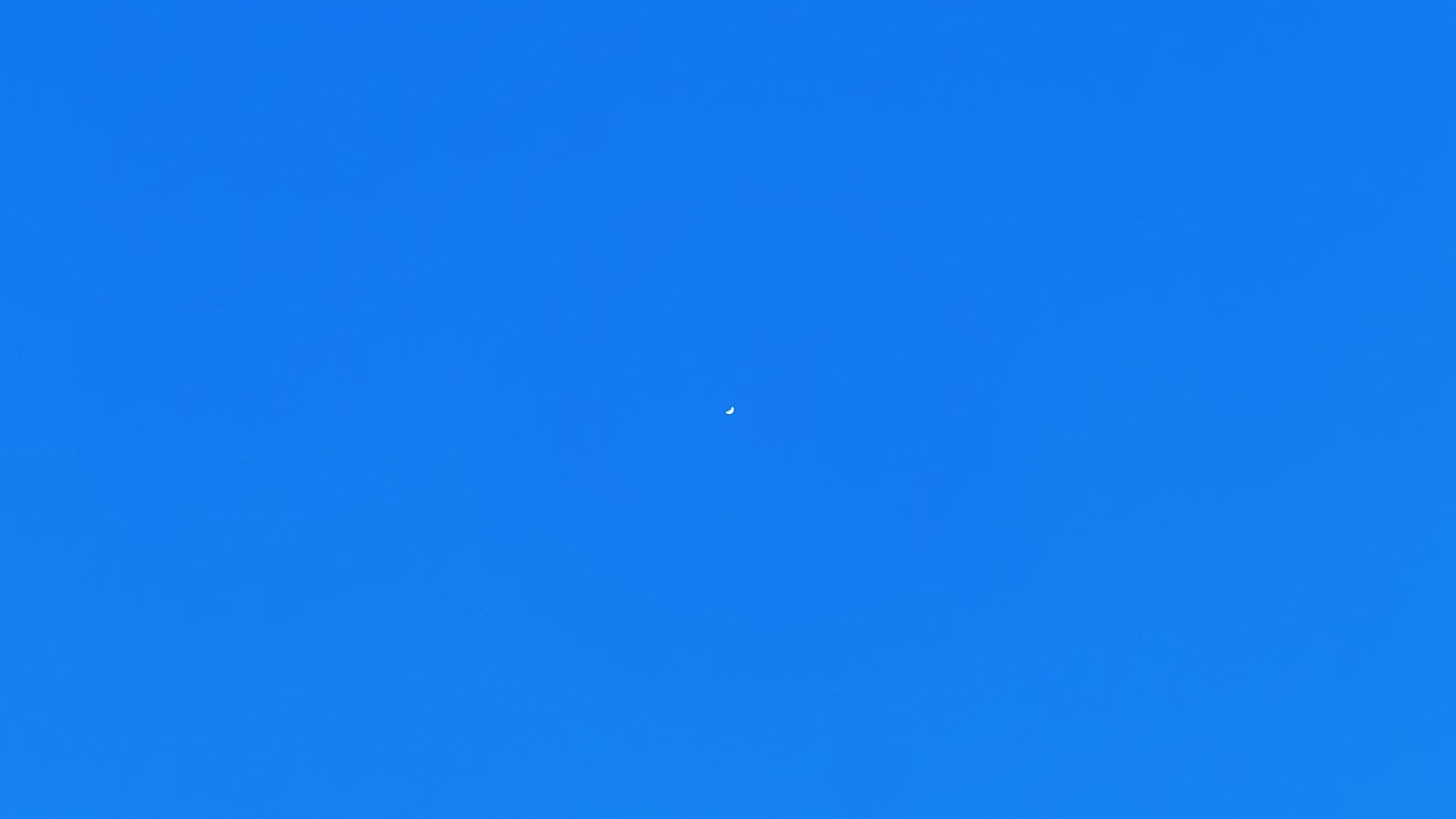

- Use the Moon. On a day the Moon passes within a few degrees of Venus, find the Moon first, then look in the listed direction and distance from it. The Moon is half a degree wide, so "3° north" is six Moon-widths. September 14, 2026 and March 4, 2027 are such days.
- Follow it past sunrise. In a morning apparition, find Venus in twilight, line it up with a tree or pole, and keep checking that line as the sky brightens.
- Catch it at the meridian. Venus is highest, and the sky around it is the darkest blue, when it's due south (Northern Hemisphere) or due north (Southern). The 360° sky gives the time and altitude.
Stand in a building's shadow so the Sun is hidden. Binoculars will find Venus faster than your eyes will, if you focus them on the Moon first. Never sweep them anywhere near the Sun, because the damage to your eyes is permanent.
What people mistake Venus for
- An aircraft. The landing lights of an approaching aircraft are the most common mix-up. Watch for 30 seconds. An aircraft moves and usually blinks, and Venus does neither.
- Jupiter. Jupiter is the only planet that comes close in brightness, but it can be anywhere along the ecliptic, including high at midnight, and it never gets brighter than about −2.9.
- Sirius. Sirius is blue-white, twinkles a lot, and is low in the south-east on winter evenings. Venus is steadier, a warmer white, and about 20 times brighter.
Venus hardly twinkles because it's a small disk and not a point, so the jitter at one edge of the disk cancels the jitter at the other. It can shimmer when it's very low, but it never flickers the way a star does.
How to photograph Venus
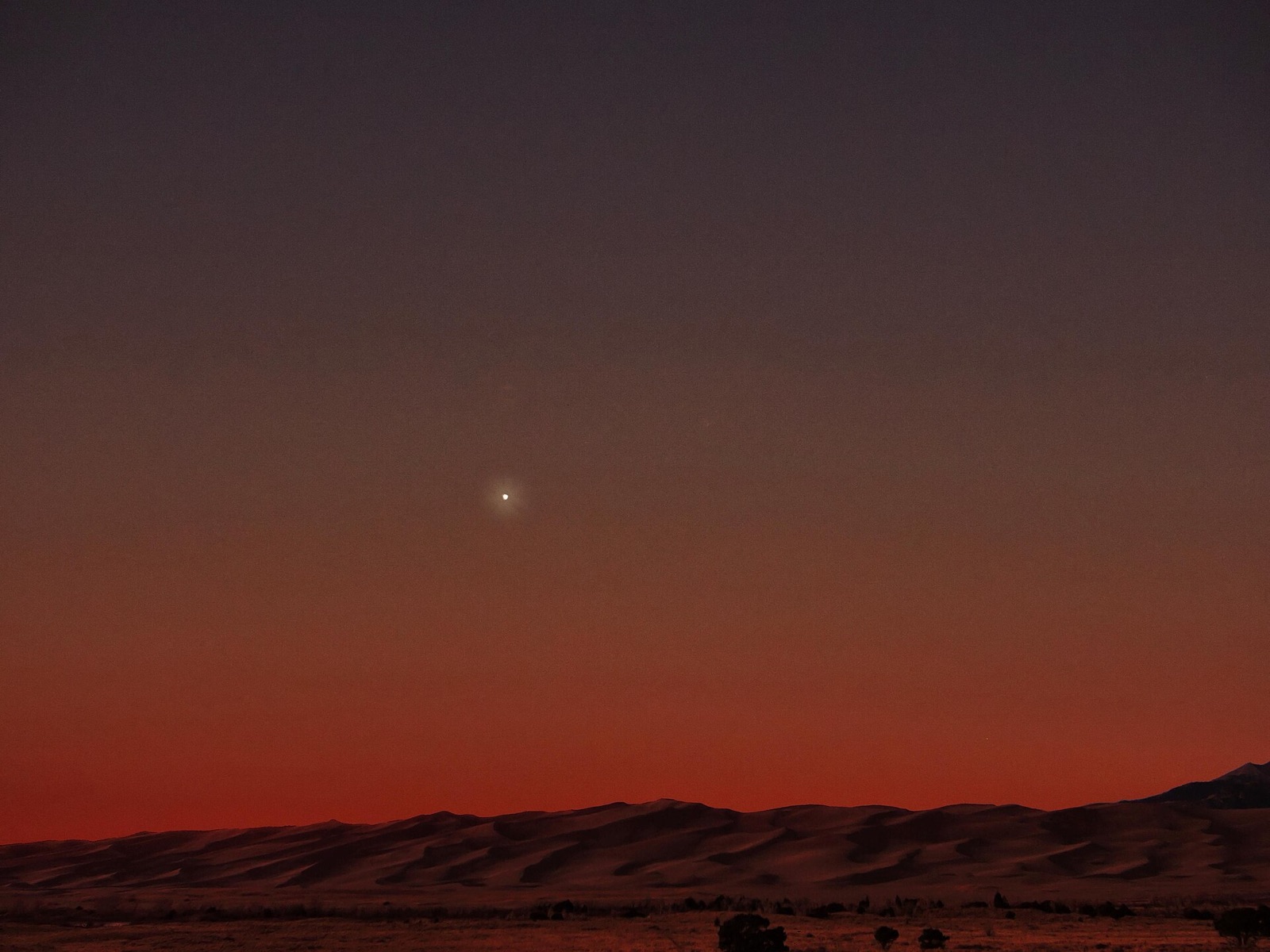
The twilight scene. Twenty to forty minutes after sunset (or before sunrise) the sky still has colour, you can still see detail in the landscape, and Venus is already a sharp point. Use a tripod, f/4, ISO 100–400, and a shutter from 1/30 s to 2 s depending on how dark the twilight is. Expose for the sky, not the planet. A 24–50 mm lens fits Venus and a foreground, and 85–135 mm fills the frame with Venus and the crescent Moon. Keep the front element clean, because any smear on the glass shows up as flare around Venus.

Venus and the crescent Moon. A few evenings each apparition the young Moon passes within a few degrees, with earthshine on its night side. Shoot early in twilight so earthshine and the sunlit sliver fit one exposure: around 1/4–1 s at f/4, ISO 200–400. The Planner's Sun/Moon direction lines help you put the pair over your landmark and not beside it.
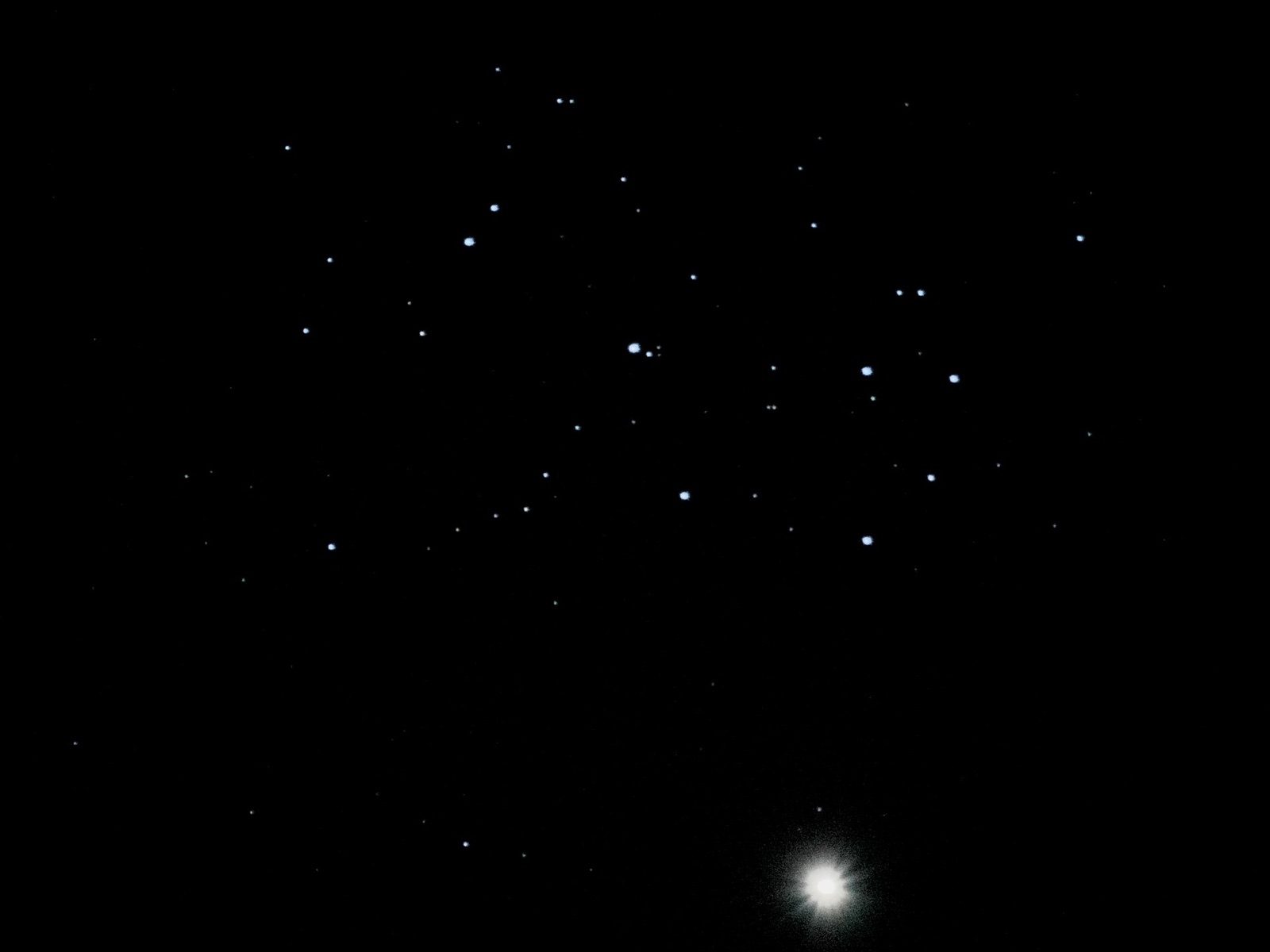
Venus in a long-exposure landscape. In a 20–30 s frame at f/2.8 Venus shows up as a big, over-exposed star with spikes from the aperture blades. Keep it away from the frame edge, where flare shows most.
The phases through a telescope. A 60 mm refractor at 50× shows the crescent clearly. A camera at 600 mm and up shows it only a few pixels across, but you can still tell it's a crescent. The exposure is short, about 1/250–1/1000 s at ISO 100–200, because Venus is a small, very bright disk. Shoot in twilight or full daylight, not in a dark sky. Against a bright background there's less glare and the air is steadier. Near inferior conjunction the crescent is over 50″ across and the "horns" extend beyond a semicircle as the atmosphere scatters sunlight round the limb. A UV or violet filter on a mid-sized telescope shows faint dusky bands in the cloud tops, and an IR-pass filter darkens a daytime sky. For the best results, record a few thousand video frames and stack the sharpest ones, which is the same method we describe in the planets guide. Camera Tools gives the field of view for your focal length and sensor, so you know how many pixels wide the crescent will be.
Common mistakes
- Looking for Venus at midnight. By then it has already set, or it hasn't risen yet. Check the set time and go out early.
- Waiting for a dark sky to photograph the crescent. Against a black sky the glare hides the phase. Shoot it in twilight or daylight.
- Exposing for the planet in a twilight scene. Venus will always be a clipped white point, so expose for the sky and landscape.
- Expecting Venus to be brightest at full or at greatest elongation. It peaks as a crescent, about five weeks either side of inferior conjunction.
- Sweeping binoculars toward the Sun in daylight. Work in a building's shadow and use the Moon as your landmark.
FAQ
Why is Venus so bright?
It's close to the Sun, so it gets a lot of light. It comes closer to Earth than any other planet, so its disk looks large. And its unbroken sulfuric-acid clouds reflect about three-quarters of the sunlight that hits them. Together these take it to magnitude −4.9.
Is Venus the morning star or the evening star right now?
As of September 2026 it's the evening star, low in the west after sunset and brightest on September 18. It passes between Earth and the Sun on October 24, 2026 and is the morning star from mid-November until summer 2027.
Why can't I see Venus in the middle of the night?
Its orbit is inside Earth's, so from here it can never be more than about 47° from the Sun. It always sets within about three hours after the Sun or rises within about three hours before it.
Can you see Venus in daylight?
Yes, with the naked eye, once you know exactly where to look. The easiest days are when the Moon is within a few degrees of it. September 14, 2026 and March 4, 2027 are the next good ones.
Sources and further reading
- EarthSky — Venus brightest in the evening sky (greatest brilliancy Sep 18, 2026, magnitude −4.8, ~40″ disk; morning brilliancy Nov 29, 2026).
- EarthSky — Inferior conjunction of Venus on October 24, 2026 (4 UTC, 6.6° south of the Sun, the 19.5-month and 8-year cycles).
- EarthSky — Venus greatest distance from the morning Sun, January 2027 (Jan 3, 2027, 19 UTC, 47°, magnitude −4.3, 50% lit) and the August 15, 2026 evening elongation.
- Fred Espenak, Astropixels — Sky Event Almanac 2027 (greatest elongation 47.0° W on Jan 3, superior conjunction Aug 12, Moon–Venus conjunctions).
- Wikipedia — Apparent magnitude (magnitudes of the Sun, Moon, Venus, Jupiter, Mars and Sirius) and Venus (albedo 0.76 Bond / 0.69 geometric, magnitude −2.98 to −4.92).
- BBC Sky at Night Magazine — How to observe and photograph a crescent Venus (daytime imaging, IR-pass filter, stacking video frames).