Moon
Supermoons, Blue Moons and the Harvest Moon: What They Really Are and How to Photograph a Full Moon
Every few months a headline announces a supermoon, a Blue Moon or a "super Harvest Moon", and the Moon that rises looks a lot like last month's. None of these is an astronomical term. Two of them describe where a full Moon falls in the calendar, and one describes a difference in distance that you can hardly see. They're still a good reason to go out at moonrise, which is the best time to photograph the Moon anyway. The question we get most is when is the next supermoon, and the answer is November 24 or December 24, 2026, depending on whose definition you use. This guide explains each name, lists the full Moons through the end of 2027, and gives the exposure and timing you need for the photograph.
At a glance
- Settings: Looney 11, meaning f/11 and a shutter of 1/ISO (ISO 100, 1/125 s), for a full Moon high in the sky. Give 2–4 stops more for an orange Moon on the horizon. RAW, manual, spot metering, tripod, 1/250 s or faster.
- When: the evening before the full-Moon date, when the Moon rises before sunset over a landscape that's still lit. Or the morning after, when it sets after sunrise.
- Where: a clear view of the moonrise azimuth, with a foreground (ridge, tower, tree line) a long way off.
- Next dates: Harvest Moon Sep 26, 2026. Supermoons Nov 24 and Dec 24, 2026 and Jan 22, 2027. Seasonal Blue Moon May 20, 2027 (UTC).
- Afterwards: if Moon and landscape need different exposures, blend two frames from the same tripod position, and say that you did.
What a supermoon actually is
The Moon's orbit is an ellipse. Perigee, its closest point, is between about 221,500 and 230,200 miles from Earth's centre. Apogee is between about 251,000 and 252,700 miles. Perigee comes round every 27.55 days and full Moon every 29.53, so a few times a year a full Moon falls within a day or so of perigee. That's a supermoon.
The word doesn't come from astronomy. The astrologer Richard Nolle coined it in 1979 in Dell Horoscope: a new or full Moon "within 90% of its closest approach to Earth", meaning in the closest tenth of the apogee-to-perigee range. Fred Espenak's tables apply that rule year by year, which works out to a limit near 228,400 miles. Timeanddate uses a fixed limit of 223,694 miles. There's no official definition, which is why one list shows three supermoons in a year and another shows one.
The difference is real but small. A perigee full Moon is up to 14% wider than an apogee "micromoon" and about 30% brighter. Compared with an average full Moon it's about 7% wider and 15% brighter. The disc is 29.3′ across at apogee and 34.1′ at perigee, so about half a degree either way. With nothing beside it for scale nobody can see a 14% change, though you may notice the extra brightness. The enormous supermoon people talk about is the Moon illusion at moonrise, and that happens every month.
Why the rising Moon looks huge, and why it's orange
A rising Moon looks huge. If you photograph it and measure it, it's the same width on the sensor as the same Moon four hours later, high in the sky. It's actually slightly smaller. On the horizon you're farther from it by about Earth's radius (1.5% of the distance), and refraction lifts the lower limb more than the upper, which flattens the disc by a few percent. The rest happens in your head. The brain treats the horizon as farther away than the zenith and scales up whatever it sees there, as in the Ponzo illusion. Nobody has fully explained it yet.
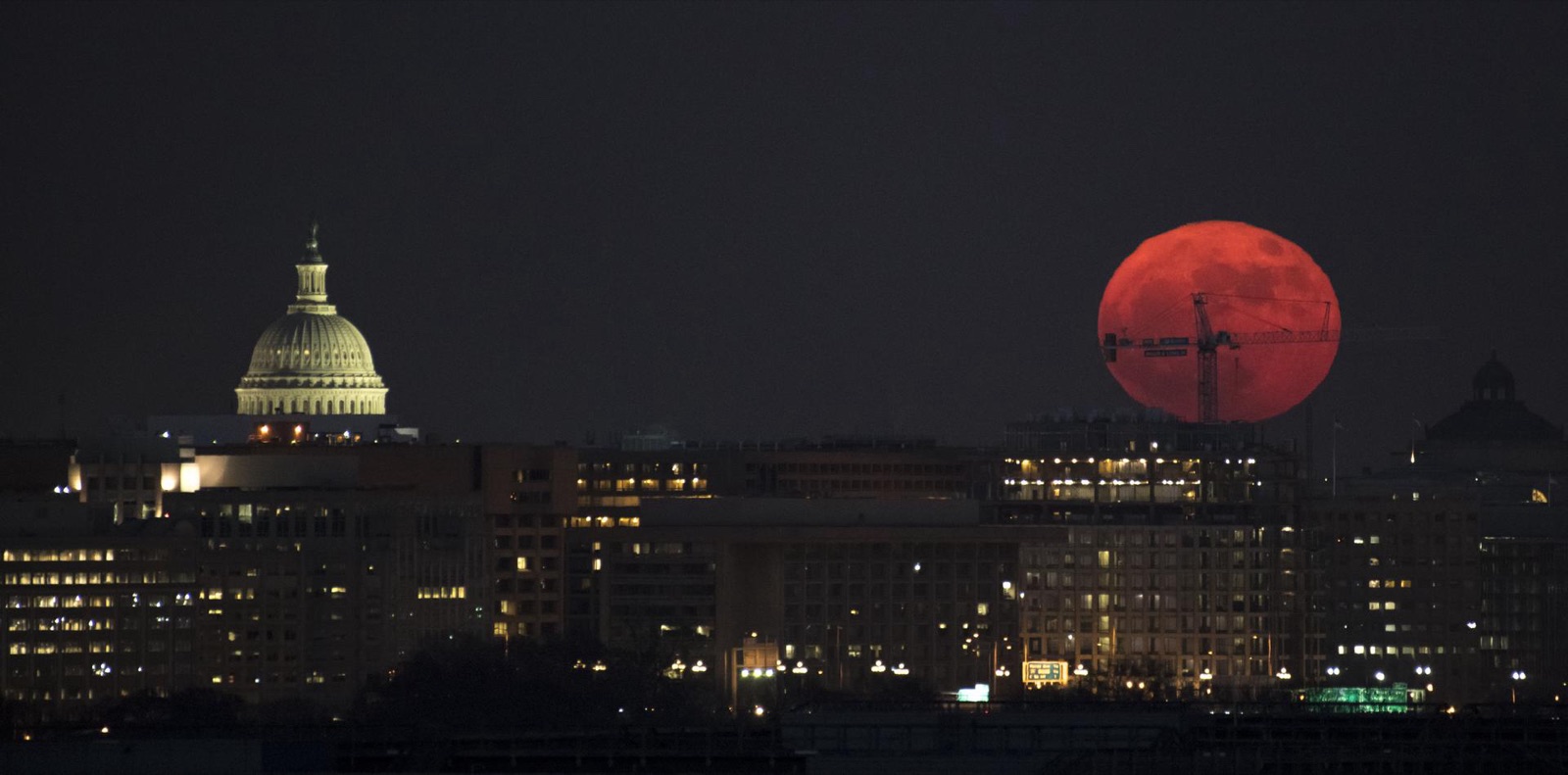
The colour is real. On the horizon, moonlight passes through a lot more air than it does overhead, and air scatters blue light more than red. The light that reaches you is orange, or sometimes deep red through smoke. It's the same Rayleigh scattering that reddens the setting Sun. The colour fades to white as the Moon climbs.
What a Blue Moon is, and when the next one falls
There are two definitions, and neither is about colour.
- Monthly: the second full Moon in a calendar month, roughly every two and a half years. May 2026 had one (May 1 and May 31), and 2027 has none.
- Seasonal: the third full Moon in an astronomical season (equinox to solstice) that holds four rather than three. This is the older rule, from the Maine Farmers' Almanac. The monthly version comes from a 1946 Sky & Telescope article that misread the almanac, and the mistake stuck. The next is May 20, 2027. The season from the March 20 equinox to the June 21 solstice has full Moons on March 22, April 20, May 20 and June 19.
The Moon only looks blue through volcanic ash or fire smoke. That's rare, and it has nothing to do with the calendar.
The Harvest Moon and why it rises early
The Harvest Moon is the full Moon nearest the September equinox, usually in September, occasionally October. In 2026 the equinox is September 23 at 00:06 UTC and the Harvest Moon is September 26 at 16:49 UTC. In 2027 it's September 15 at 23:04 UTC. The full Moon after it is the Hunter's Moon.
What's different about it is when it rises. On average the Moon rises about 50 minutes later each night, because it moves about 13° eastward per day and Earth has to turn that much further to bring it up. But the delay depends on the angle the Moon's path makes with the horizon. Around the September equinox, from mid-northern latitudes in the evening, the ecliptic meets the eastern horizon at its shallowest angle of the year. The Moon's daily movement is then mostly along the horizon rather than below it, and each moonrise comes only 20–30 minutes after the previous night's. You get a bright Moon low in the east right after sunset on four or five evenings in a row. That makes it the easiest full Moon of the year to photograph. If you lose one evening to cloud, the next is nearly as good. In the southern hemisphere the same thing happens around the March equinox.
Full Moon names
The common names come from the Farmers' Almanac and go with the calendar month. The Harvest Moon is the exception, because it follows the equinox.
| Month | Name | Also called |
|---|---|---|
| January | Wolf Moon | Old Moon, Moon After Yule |
| February | Snow Moon | Hunger Moon, Storm Moon |
| March | Worm Moon | Crow Moon, Sap Moon, Lenten Moon |
| April | Pink Moon | Sprouting Grass Moon, Egg Moon |
| May | Flower Moon | Corn Planting Moon, Milk Moon |
| June | Strawberry Moon | Rose Moon, Honey Moon |
| July | Buck Moon | Thunder Moon, Hay Moon |
| August | Sturgeon Moon | Green Corn Moon, Grain Moon |
| September | Corn Moon / Harvest Moon | Harvest Moon = full Moon nearest the equinox |
| October | Hunter's Moon | Travel Moon, Dying Grass Moon |
| November | Beaver Moon | Frost Moon, Mourning Moon |
| December | Cold Moon | Long Nights Moon, Moon Before Yule |
Full Moon and supermoon dates, October 2026 to December 2027
Times are the instant of full Moon in UTC, from Fred Espenak's phase tables. Convert to your zone before deciding which evening is "the night before". A time just after midnight UTC can fall on a different date where you are.
| Full Moon (UTC) | Name | Distance | Notes |
|---|---|---|---|
| Oct 26, 2026 04:12 | Hunter's Moon | — | |
| Nov 24, 2026 14:53 | Beaver Moon | 224,171 mi | Supermoon under the 90% rule (Espenak, EarthSky). Misses the 223,694 mi line by 477 mi |
| Dec 24, 2026 01:28 | Cold Moon | 221,668 mi | Supermoon by every definition. Closest full Moon of 2026 |
| Jan 22, 2027 12:17 | Wolf Moon | 222,230 mi | Supermoon by every definition. Closest full Moon of 2027 |
| Feb 20, 2027 23:24 | Snow Moon | 225,748 mi | Supermoon on Espenak's list only. Penumbral lunar eclipse |
| Mar 22, 2027 10:44 | Worm Moon | — | |
| Apr 20, 2027 22:27 | Pink Moon | — | |
| May 20, 2027 10:59 | Flower Moon | — | Seasonal Blue Moon |
| Jun 19, 2027 00:44 | Strawberry Moon | — | |
| Jul 18, 2027 15:45 | Buck Moon | — | Penumbral lunar eclipse |
| Aug 17, 2027 07:29 | Sturgeon Moon | — | Penumbral lunar eclipse |
| Sep 15, 2027 23:04 | Harvest Moon | — | Nearest the Sep 23 equinox |
| Oct 15, 2027 13:47 | Hunter's Moon | — | |
| Nov 14, 2027 03:26 | Beaver Moon | — | |
| Dec 13, 2027 16:09 | Cold Moon | — |
So the answer to "when is the next supermoon" depends on whose rule you use. The rest of 2026 has one or two, and 2027 has one or two. The three penumbral eclipses of 2027 only shade one edge of the disc faintly. The next total lunar eclipse is December 31, 2028.
Moon Details in Still Dark shows the Moon's distance and apparent diameter for any moment, the next perigee and apogee, and the next full and new Moon, so you can check how close any full Moon comes. Sky Events → Moon lists supermoons and lunar eclipses with local times and reminders, so you get the answer to "when is the next supermoon" in your own time zone. The Sun & Moon card gives moonrise and moonset with azimuths alongside sunset, which are the numbers you need for the "day before" plan below.
How to photograph the full Moon: exposure and focal length
The full Moon is a grey rock in full sunlight, about as bright as a sunlit road at noon, whatever the sky around it looks like. A meter that averages the frame reads mostly black sky and overexposes the disc to white. So:
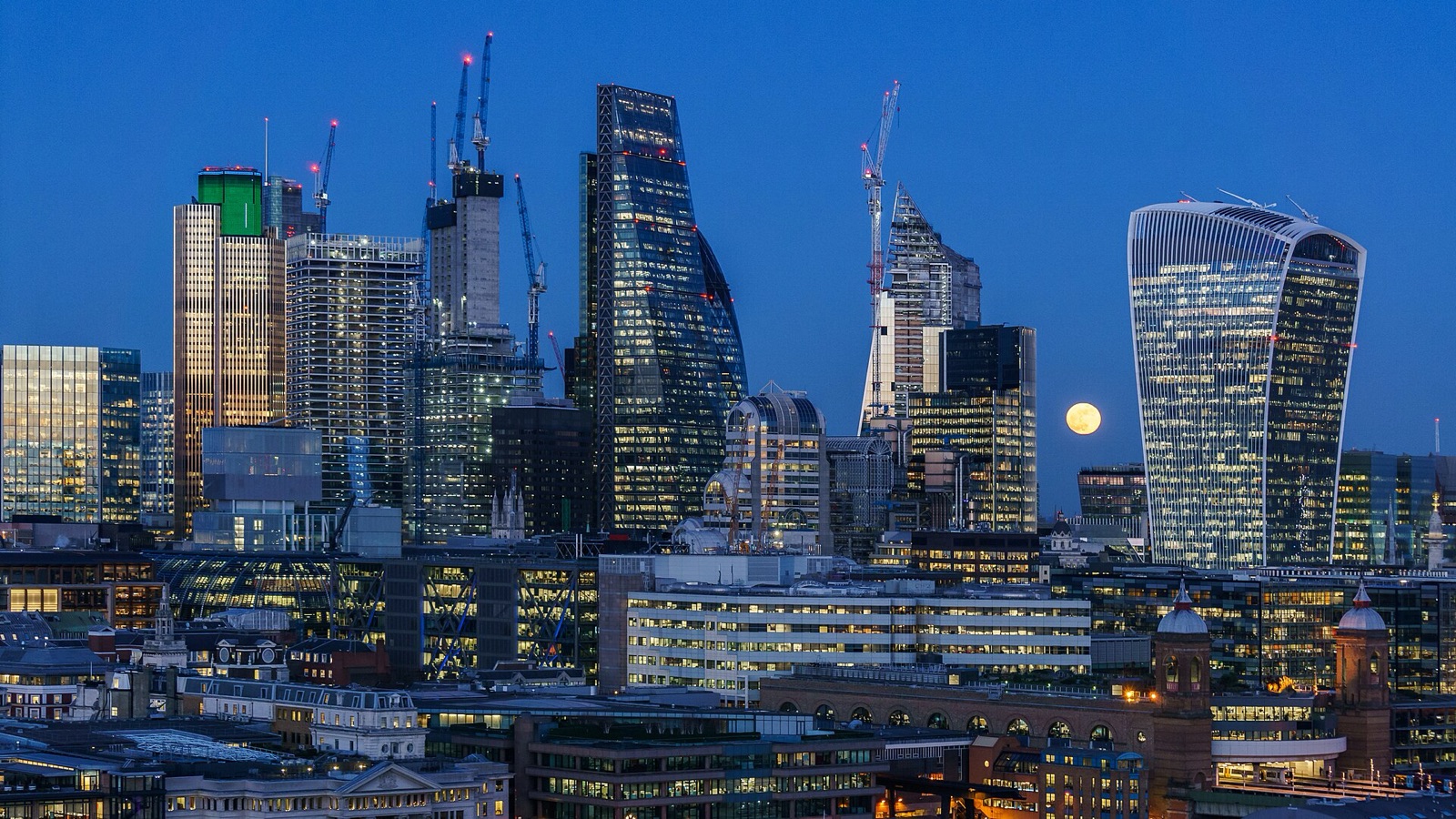

- Start with Looney 11: f/11 and a shutter of 1/ISO. ISO 100 at 1/125 s, ISO 200 at 1/250 s, ISO 400 at 1/500 s. It's Sunny 16 opened one stop, because the Moon reflects less than a daytime scene. Any equivalent exposure works.
- Correct for altitude. Looney 11 is for a full Moon high in a clear sky. A Moon just above the horizon is dimmed by the same air that turns it orange, and it needs 2–4 stops more. Put the disc in the upper quarter of the histogram, off the right edge. A supermoon needs no extra exposure, because surface brightness doesn't change with distance. Only the size does.
- Spot meter or go manual. If you meter, put the spot on the Moon and add about +1 stop.
- RAW, bracketed a stop either side. The full Moon has no shadows and looks flat, but you can bring the contrast back in processing.
- 1/250 s or faster, because unsteady air makes the limb ripple.
- Tripod, mirror lock-up or electronic shutter, remote or 2-second timer. Manual focus at maximum magnification on a crater rim, not the bright limb.
On the sensor the half-degree disc is roughly the focal length divided by 109 across, so 400 mm gives a 3.7 mm Moon. How big that looks depends on the sensor.
| Focal length | Moon on sensor | Share of frame height, full frame (24 mm) | Share of frame height, APS-C (15.6 mm) |
|---|---|---|---|
| 200 mm | 1.8 mm | 8% | 12% |
| 400 mm | 3.7 mm | 15% | 24% |
| 600 mm | 5.5 mm | 23% | 35% |
| 800 mm | 7.3 mm | 31% | 47% |
| 1200 mm | 11.0 mm | 46% | 71% |
A 24-megapixel full-frame sensor at 400 mm puts the Moon across about 620 pixels, which is enough for a clean crop. For a Moon that looks big in a landscape you need 600 mm or more and a foreground several miles away. For craters and the terminator rather than the whole disc, see photographing the Moon with a telephoto lens.
Shoot the day before full, not the day of
On the full-Moon date the Moon rises at about sunset, opposite the Sun, and by the time it clears the horizon haze the landscape is dark. You get a bright disc over a black silhouette, and no single exposure holds both. The evening before, the Moon is 97–99% lit, which nobody can tell from full, and it rises 30–50 minutes before sunset while the landscape is still in daylight. For 15–20 minutes, Moon, sky and ground are within two or three stops of each other. The morning after works the same way in reverse. The Moon sets after sunrise over ground lit by low sun. (The timetable for every phase is in Moon phases for photographers.)
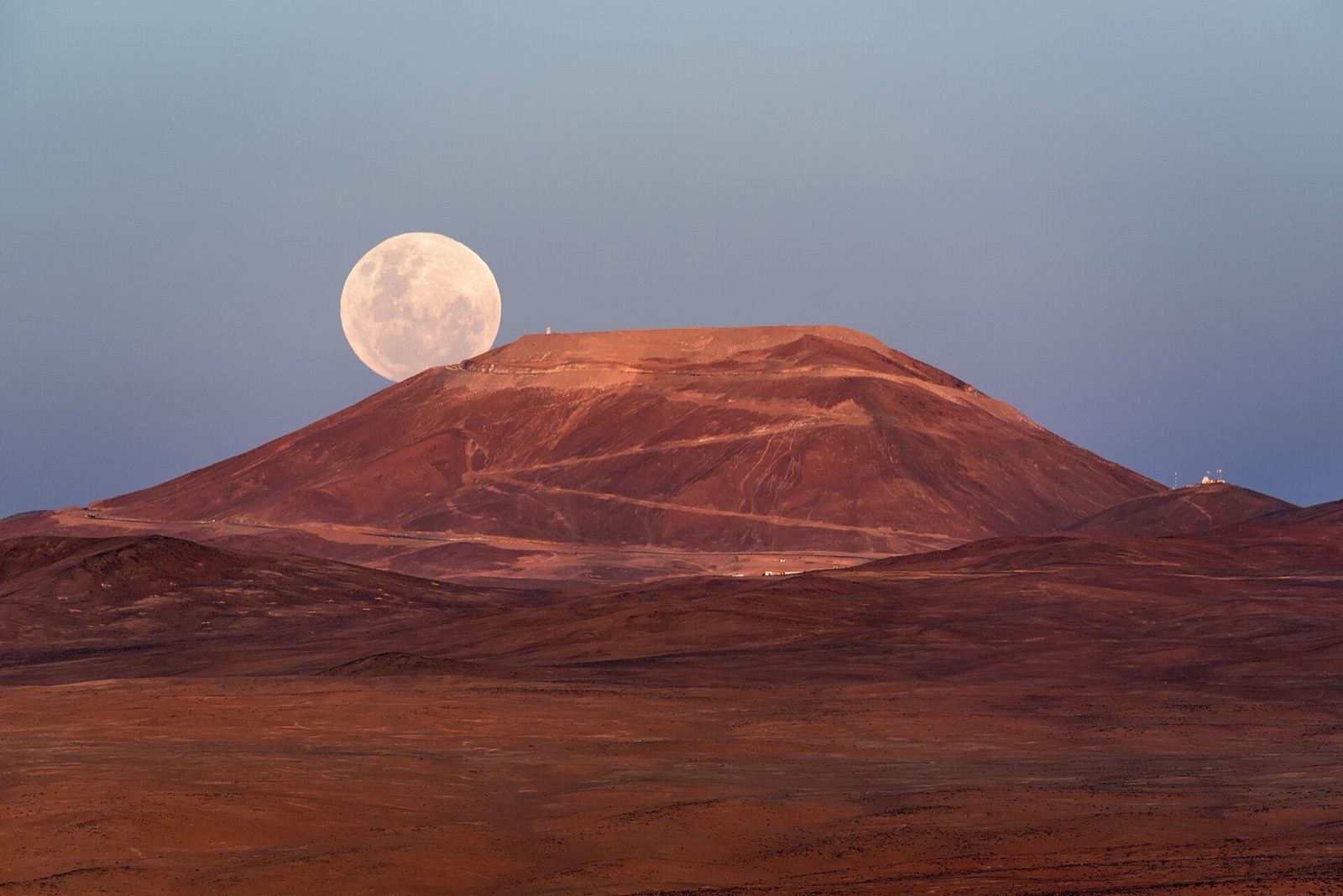

- Read the times: moonrise, sunset and the moonrise azimuth for the evening before full, at your location.
- Find a foreground on that azimuth, low on the horizon and far enough away to be sharp at your focal length. The Moon climbs roughly 10° in its first hour.
- Arrive 30 minutes before moonrise. The Moon appears dim and orange, sometimes hard to find in the haze, and brightens 2–3 stops in the next quarter hour. Keep re-metering, because the exposure you set at moonrise is wrong ten minutes later.
- Bracket three frames at 1-stop steps.
- If the range is still too wide, take one frame for the ground and one for the Moon from the same tripod position, minutes apart, and blend them. Keep the Moon at the size and place the lens recorded. A Moon pasted in at three times its real size is a composite, not a photograph, and people can tell.
On a phone: turn night mode off, or it stacks long exposures for the sky and turns the Moon into a white blob. Tap and hold on the Moon to lock exposure there and drag the slider down until the disc shows texture. Use the longest real lens the phone has. Beyond the 3× or 5× telephoto, zoom is only a crop, and a half-degree Moon covers only a few dozen pixels on the main camera. A phone does better with the twilight scene and a small, correctly exposed Moon in it, and that can be a good picture.
The Planner draws the moonrise direction on the map and overlays the field of view for your focal length and sensor, so you can see whether the Moon clears a ridge inside the frame before the light goes. The altitude curve on the timeline shows how high it is at any minute. To line a full Moon up behind a specific tower or peak, use the "stand here" method in How to photograph a huge Moon behind a building. Camera Tools has the Moon exposure recipe with the altitude correction built in.
Common mistakes
- Going out on the full-Moon date and finding the landscape black by the time the Moon is up. Go the evening before.
- Auto exposure, which averages the black sky and burns out the disc.
- Expecting a supermoon to look bigger. The eye can't judge a 7% change in an isolated disc.
- A slow shutter on a long lens. Keep it at 1/250 s or faster and raise ISO instead.
- Guessing the moonrise point. The azimuth shifts by degrees a night, so check it for the date.
FAQ
Is a supermoon actually bigger?
Not that you can see. A perigee full Moon is up to 14% wider than an apogee one and about 7% wider than average, and there's nothing beside it for scale. It is brighter, and that's what people notice. The giant Moon at moonrise is the Moon illusion, which happens every month.
When is the next supermoon?
November 24, 2026 (14:53 UTC) under the 90%-of-perigee rule, or December 24, 2026 (01:28 UTC) by the stricter 223,694-mile line. December's is the closest full Moon of 2026 at 221,668 miles. January 22, 2027 (12:17 UTC) is the closest of 2027. Sky Events → Moon gives the time in your zone.
What settings should I use to photograph the full Moon?
Manual, f/11, shutter 1/ISO (for example ISO 200 at 1/250 s) with the Moon high in the sky, and 2–4 stops more near the horizon. Spot meter on the disc, RAW, manual focus.
Why is the Moon orange when it rises?
Its light crosses far more air on the horizon than overhead, and air scatters blue out of the beam more than red, the same scattering that reddens the setting Sun. The colour fades as the Moon climbs.
Is a Blue Moon actually blue?
No. A monthly Blue Moon is the second full Moon in a calendar month, and a seasonal one is the third of four in an astronomical season. The next is a seasonal Blue Moon on May 20, 2027. The Moon looks blue only through volcanic ash or fire smoke, whatever the calendar says.
Sources and further reading
- Fred Espenak, AstroPixels — Phases of the Moon: 2001 to 2100 (all full-Moon dates and UT times in the table).
- Fred Espenak, AstroPixels — Full Moon at Perigee (Supermoons): 2001 to 2100 (the 90% rule, supermoon dates and distances for 2026–2027).
- NASA Science — Supermoons (definition; 14% bigger and 30% brighter than the year's faintest Moon; hard to detect by eye).
- NASA Science — The Moon Illusion: Why Does the Moon Look So Big Sometimes? (the horizon Moon is the same width; Ponzo illusion).
- EarthSky — When is the next Blue Moon? (monthly vs seasonal definitions, Maine Farmers' Almanac and the 1946 Sky & Telescope article, May 20, 2027).
- Farmers' Almanac — Full Moon Names (the month names and the Harvest Moon rule).