Gear
How to Choose a Lens for Astrophotography: Focal Length, Aperture and the Flaws That Matter
Stars are hard on a lens. They're points of light on a black background, you shoot them wide open for twenty seconds at a time, and they fill the frame right into the corners. Flaws you'd never notice in daylight show up clearly. So the best lens for astrophotography isn't always the one with the fastest aperture printed on the barrel. This guide goes through what matters, most important first, so you can judge any lens from its numbers and a ten-minute test. We talk about types of lens here, not specific models.
At a glance
- Order of importance: usable aperture first, focal length second, corner star quality third. Everything else comes a long way after.
- Aperture: f/1.4 gathers 4× the light of f/2.8, and f/2 gathers 2×. But if you have to stop a lens down to f/2.8 for clean corners, it's an f/2.8 lens for stars.
- Focal length: 14–24 mm for the Milky Way over a landscape, 35–85 mm for constellations, 135–200 mm on a tracker for Andromeda and Orion.
- The test: shoot a star field wide open and at ⅓, ⅔ and 1 stop down, then look at the corners at 100%.
- First purchase: a 20 or 24 mm f/1.4–1.8 prime. It does more for night photography than any other single lens.
1. Aperture: light per pixel
The light reaching each square millimetre of sensor goes up with the inverse square of the f-number. f/1.4 is two stops faster than f/2.8, and each stop doubles the light, so an f/1.4 lens gives (2.8 ÷ 1.4)² = 4× as much light per pixel as an f/2.8 lens in the same exposure. An f/2 lens gives (2.8 ÷ 2)² ≈ 2×, and an f/1.8 about 2.4×.
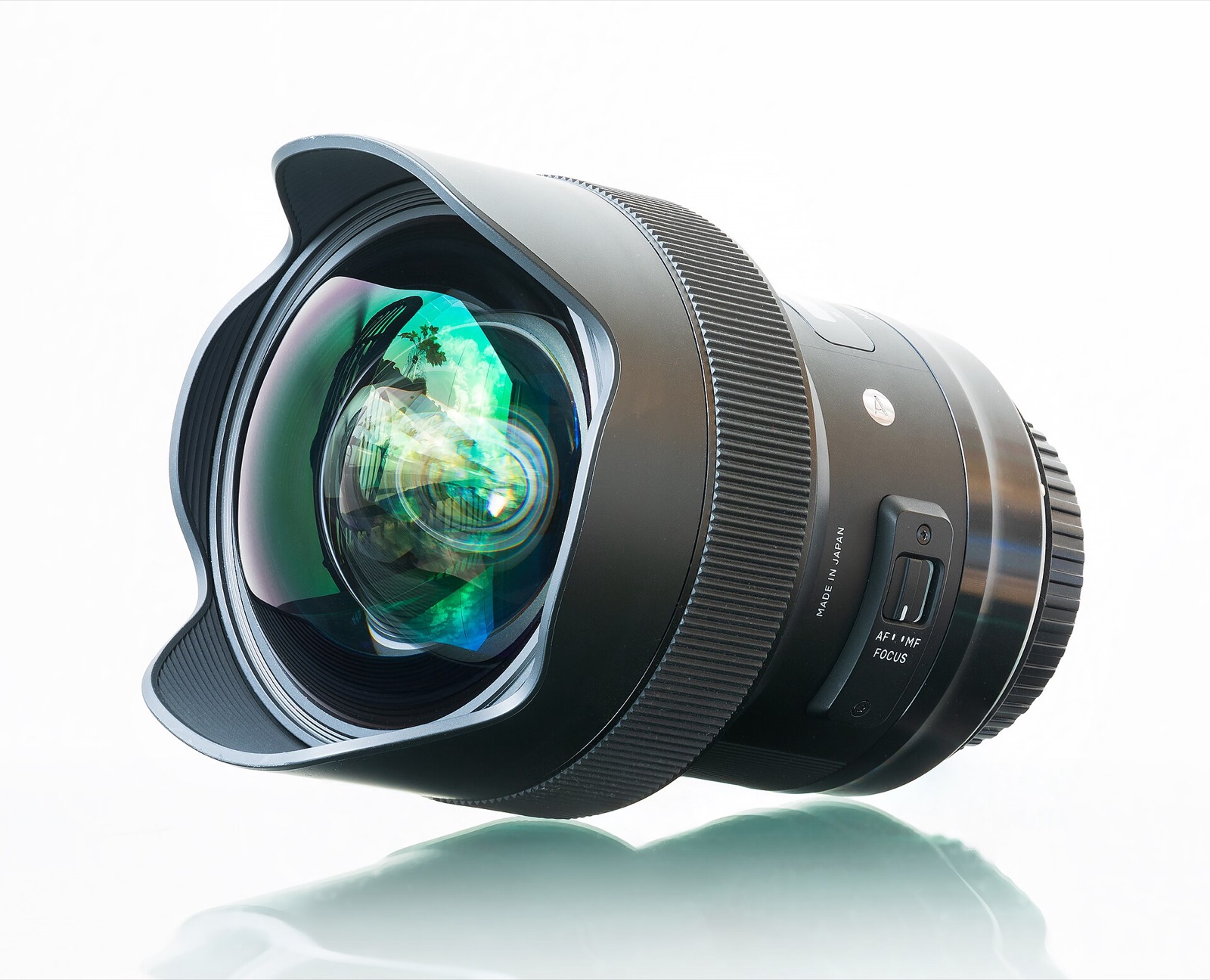

In daylight this hardly matters. At night it matters more than anything else about the lens. The sky is faint and you can't expose for long before the stars trail, so the only way to get more light into each frame is a wider aperture. Raising the ISO doesn't add light. With four times the light at f/1.4 you can shoot at ISO 1600 instead of ISO 6400 for the same brightness.
The problem is the corners. Almost every lens is at its worst wide open, and stars make that easy to see. If a lens gives smeared corner stars with wings at f/1.4 and they only clean up at f/2.8, then for astrophotography it's an f/2.8 lens. The extra speed only makes it easier to focus. Judge a lens by the widest aperture where you'd be happy with the corners in a print, not by the number on the barrel.
2. Focal length and what it frames
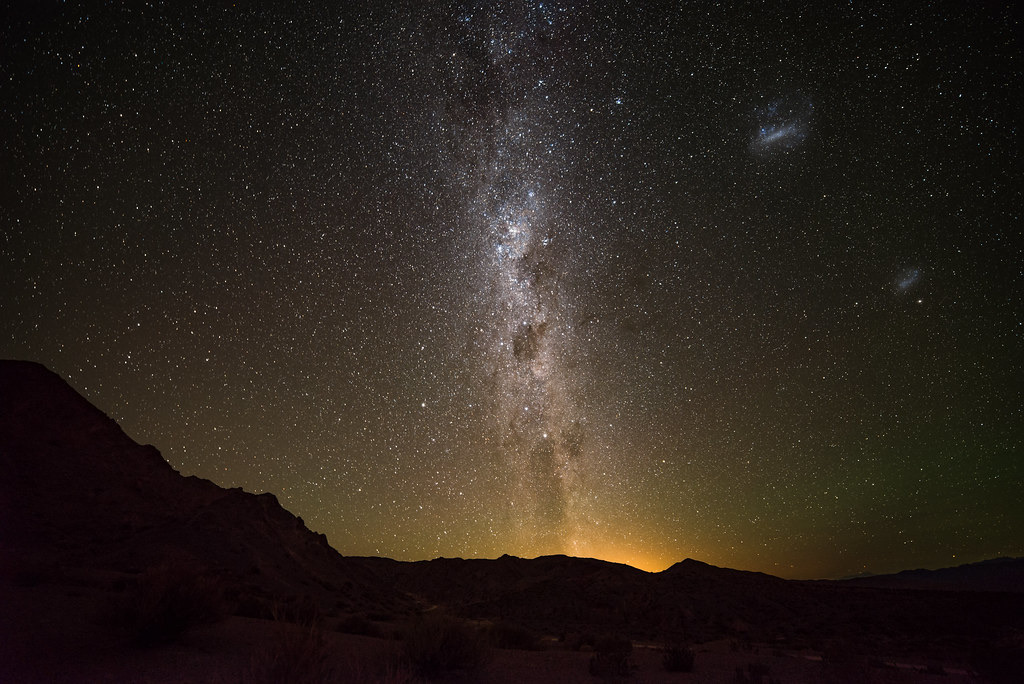
Focal length sets the field of view. The field of view decides what you can fit in the frame and how long you can expose before the stars trail. The table gives the horizontal field for a full-frame sensor (36 mm wide) and a typical APS-C sensor (23.5 mm), worked out from FOV = 2·atan(w ÷ 2f). Micro Four Thirds (17.3 mm) is narrower again, and 14 mm on MFT covers 63°.
| Focal length | Full frame | APS-C | What it frames |
|---|---|---|---|
| 14 mm | 104° | 80° | Most of the Milky Way arch, or the whole arch in a two-frame panorama |
| 16 mm | 97° | 73° | Arch sections, aurora, meteor showers |
| 20 mm | 84° | 61° | Galactic core over a landscape |
| 24 mm | 74° | 52° | Core plus foreground, the classic nightscape |
| 35 mm | 54° | 37° | Core detail, large constellations (Orion, Scorpius) |
| 50 mm | 40° | 26° | Single constellations, conjunctions with a landmark |
| 85 mm | 24° | 16° | Compact constellations, the Pleiades region |
| 135 mm | 15° | 10° | Andromeda, the Orion Nebula and Belt (on a tracker) |
| 200 mm | 10° | 7° | Andromeda filling a quarter of the frame, bright nebulae (on a tracker) |
| 400 mm | 5.2° | 3.4° | The Moon at a useful size (it spans 0.5°). Planets are still dots. |
There are two things to take from the table. First, you can't photograph planets with a camera lens. To show a planet as a disc you need several thousand millimetres of focal length, and that means a telescope. Second, a wider lens lets you expose for longer. Trailing goes up with focal length, so the NPF rule gives a 14 mm lens about 1.7× the exposure of a 24 mm, which is nearly double. The 500 rule and NPF rule guide shows how to work it out for your pixel pitch.
Still Dark Camera Tools stores your camera body and lens, and computes the field of view and the NPF and 500-rule exposure limits for that combination. The Planner's camera field-of-view overlay then draws exactly what a given focal length covers from your chosen spot (the core, the arch, a mountain with the Moon behind it). You can check whether a 20 mm or a 35 mm will do the job before you buy one, or before you carry it up the hill.
3. The flaws that stars expose
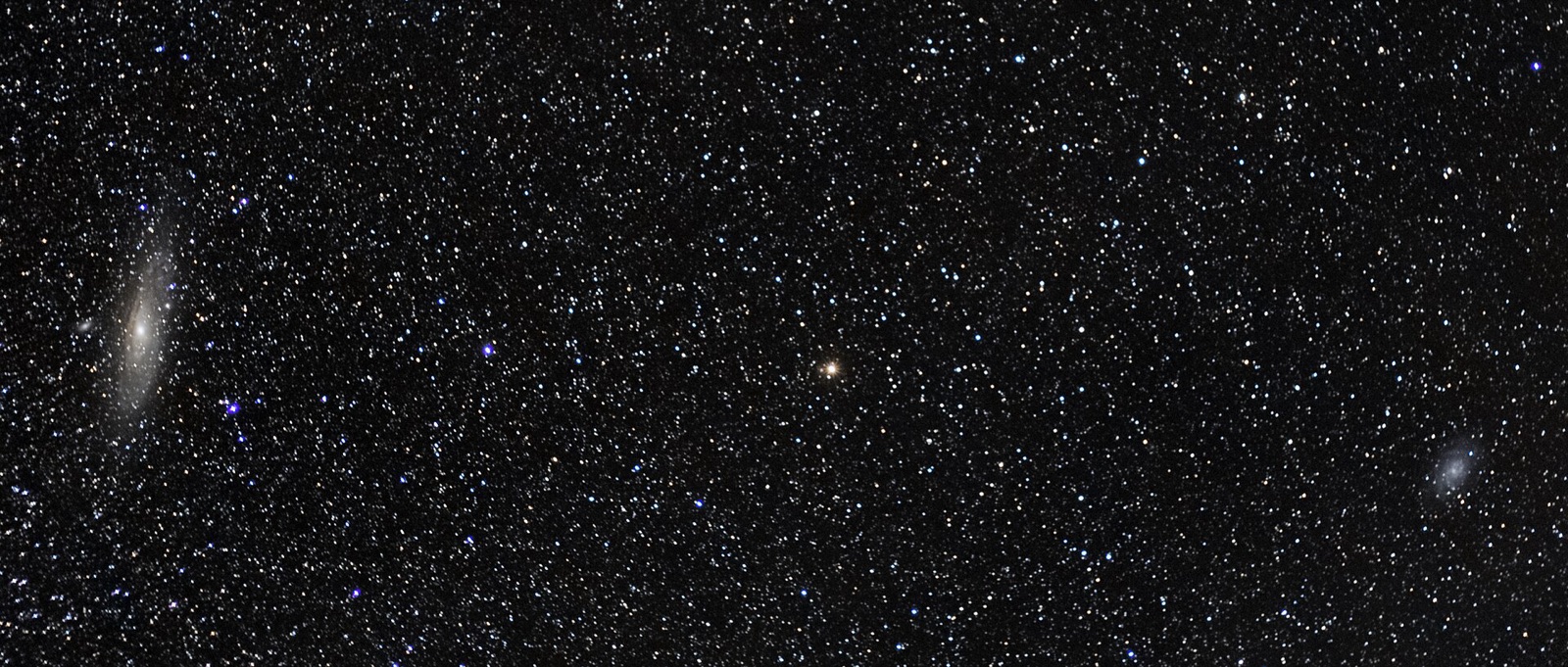
A star is a point of light, so anything the lens does wrong to it is easy to see. Lenses are at their worst in the corners.
.jpg)
| Flaw | What it looks like on stars | Fix |
|---|---|---|
| Coma | Corner stars get comet tails or turn into seagull / V shapes pointing away from centre. Worst wide open. | Stop down ⅓–1 stop, choose a lens designed for coma, or crop the corners |
| Astigmatism | Stars stretch into short lines or crosses, radial (tangential) or circumferential (sagittal) around the centre | Stop down, or refocus slightly to balance the two foci. Otherwise it is part of the lens design. |
| Sagittal flare / "wings" | Bright corner stars get a pair of wings tangential to the frame edge, a mix of coma and astigmatism | Stop down 1 stop. This is the flaw that decides a lens's usable aperture. |
| Chromatic aberration | Purple, blue or green fringes on bright stars. Lateral CA grows toward the corners. Longitudinal CA is colour on either side of focus everywhere. | Lateral CA corrects well in RAW software. Longitudinal CA improves when you stop down. Use defringe tools for the rest. |
| Vignetting | Bright centre, dark corners. The gradient is hard to separate from light pollution. | Profile correction in software, at the cost of extra corner noise. Stopping down 1–2 stops reduces it. |
| Field curvature | Centre sharp, edges soft even when focus is perfect, or the reverse when you focus at the edge | Focus a third of the way out from centre as a compromise. Stop down. Use a flattener on telescopes. |
| Distortion | Straight horizons bow outward or inward | Doesn't matter for stars. Correct in software for foregrounds. |
| Ghosting / sensor reflections | A faint mirrored disc opposite a bright star or the Moon, or a coloured halo around the star itself | Keep the Moon out of frame. Use the hood. Remove filters, which add reflecting surfaces. |
Coma happens when magnification varies across the aperture, so a point away from the centre is drawn out into a wedge. Astigmatism happens when rays in two perpendicular planes focus at different distances, so a point becomes a line. Fast wide lenses usually have both, and both get much better when you stop down. Vignetting does more harm than it seems to. A lens that loses two stops in the corners at f/1.4 is an f/2.8 lens in those corners, and when you correct it in software you brighten the noise along with the sky.
4. How to test a lens for astrophotography in ten minutes
Lonely Speck's aberration test photographs a grid of white dots on a screen and measures how far the corner dots spread from points, as a percentage of frame height (under 0.4% is excellent, over 1% poor). You can do the same thing with real stars in about ten minutes, and it will tell you whether to keep the lens or send it back:
- Set up on a tripod with stars in every corner of the frame, away from the horizon and the Moon.
- Focus carefully on a bright star at the centre, using live view at maximum magnification.
- Shoot the same field four times: wide open, then ⅓, ⅔ and 1 stop down. Keep the exposures short so the stars don't trail, 5–8 s each.
- View each frame at 100% and compare the corners, then halfway out, then the centre. Note the first aperture where the corner stars are round.
- Repeat with focus set on an edge star. If the corners get sharper and the centre gets softer, the lens has field curvature. It isn't a bad copy.
The aperture you noted in step 4 is the one to use for stars. If one corner is clearly worse than the corner diagonally opposite, the copy is de-centred and you can exchange it.
5. Primes vs zooms for astrophotography
Most nightscape photographers use an f/2.8 wide zoom, a 14–24 mm or a 16–35 mm. These zooms cover the top half of the table, and the modern ones control coma well. f/2.8 with 20–25 s at ISO 3200–6400 gives a clean Milky Way from a dark site, especially if you stack. If you already own one, use it. It's a good night lens.
Fast primes gather more light. An f/1.4 or f/1.8 prime at 20 or 24 mm collects 2.4–4× more per frame than the zoom, which can mean you don't need to stack at all. A prime is also simpler to make well. The downside is that you get one focal length, and the fastest primes weigh more than a zoom that covers three of them.
6. Manual vs autofocus
Autofocus doesn't help at night. There's nothing for it to lock on to, so you'll focus manually in live view whichever lens you own. That means a manual lens is no disadvantage. Its hard stops, long throw and distance scale let you go back to a known infinity setting in the dark and tape the ring there. Focus-by-wire lenses (most modern autofocus designs) have no end stops, the throw changes with how fast you turn the ring, and the position may reset when you switch off. They focus precisely, but you have to refocus every time. The focus-at-night guide covers both.
7. Filter threads, weight and mounts
Filters. Many of the fastest ultra-wides have a bulbous front element and a fixed petal hood, and can't take a screw-in filter. That's a problem if you want to use a Bahtinov focusing mask or a light-pollution or narrowband filter. Some have a rear gel slot for cut sheet filters. If yours doesn't and you plan to use filters, choose a lens with a normal thread, and check the thread size before you buy a mask.
Weight. An f/1.4 wide prime with a fixed hood can weigh over two pounds, and a compact f/1.8 or f/2 prime a third of that. A heavier lens needs a heavier tripod. On a light travel tripod a heavy lens shakes in the wind during a 20-second exposure, so either budget for a sturdier tripod or choose the lighter lens. A lens that stays in the car because it's too heavy to carry is no use to you.
Mounts. Any mount works. Adapters cause no trouble with manual lenses because nothing electronic passes through them. A mirrorless body has a short flange distance, so you can adapt old manual primes, and many of those are excellent on stars once you stop them down a little.
8. Crop sensors: APS-C, Micro Four Thirds and equivalence
A smaller sensor sees a narrower field through the same lens. Multiply the focal length by the crop factor (1.5 for most APS-C, 2 for Micro Four Thirds) to get the full-frame lens that gives the same view. A 14 mm on APS-C frames like a 21 mm on full frame, and a 12 mm on MFT like a 24 mm.
The f-number still describes light per square millimetre, so f/2.8 puts the same intensity on an MFT sensor as on a full-frame one. But the MFT sensor has a quarter of the area, so it collects a quarter of the total light in the same exposure, and total light is what decides how noisy the finished picture is. That's what "equivalent aperture" means. The crop factor multiplies the f-number as well as the focal length, so a 12 mm f/2.8 on MFT matches a 24 mm f/5.6 on full frame for framing and total light. That's no reason to avoid small sensors. An MFT 12 mm f/1.4 is a usable 24 mm f/2.8 equivalent. It does mean a fast prime matters even more on a small sensor.
9. Phones
With a phone you don't get to choose the lens. It has a fixed aperture around f/1.8 on a sensor a fraction of the size of MFT, and a night mode that stacks many short frames automatically. Its equivalent aperture works out near f/8–f/10 on full frame, which is why phone night shots look smooth but lack detail. A phone on a tripod will show the Milky Way core from a dark site, and the phone guide covers how. This guide picks up where that one ends.
10. Telescopes as lenses
Past 200 mm, a small telescope usually does better than a camera lens for deep-sky work. A small apochromatic refractor of 60–80 mm aperture at 400–600 mm focal length and f/5–f/7, with a field flattener and a tracker, gives round stars to the corners, very little vignetting and a focuser that doesn't creep. A camera telephoto struggles with all of those on nebulae and galaxies, and the refractor weighs about the same. It's no good for landscapes and it always needs the tracker, because at 500 mm the untracked limit is a fraction of a second.
11. What to buy first, and in what order
- The kit zoom. An 18–55 mm or 24–70 mm at f/3.5–4 is slow, but it works. Use the widest end, wide open, 20 s at ISO 6400, and stack twenty frames. You can learn focus and framing with it before you spend anything.
- One fast prime. A 20 or 24 mm f/1.4–1.8 gives two to four times the light of the zoom and better corners, and it weighs less. If you buy one lens for astrophotography, buy this.
- The wide f/2.8 zoom. A 14–24 mm or 16–35 mm covers the arch, aurora and meteor showers at the wide end and the core with a foreground at the long end. Together with the prime, it covers nearly every nightscape.
- A tracker and a 135 mm. With a star tracker, any f/2–2.8 lens from 85 to 200 mm can shoot deep-sky objects. Andromeda, the Orion Nebula and the Pleiades all fit in the frame at 135 mm. Two-minute tracked exposures at f/2.8, stacked, show far fainter detail than any untracked wide-field shot.
| Subject | Focal length (full frame) | Aperture | Tracker? |
|---|---|---|---|
| Milky Way arch, aurora, meteors | 14–20 mm | f/1.4–2.8 | No |
| Galactic core over a landscape | 20–35 mm | f/1.4–2.8 | Optional |
| Constellations, conjunctions with foreground | 35–85 mm | f/1.8–2.8 | Helpful past 50 mm |
| Andromeda, Orion Nebula, Pleiades | 135–200 mm | f/2–2.8 | Yes |
| Moon, full disc | 400–600 mm | f/5.6–8 | No |
| Small nebulae, galaxies | 400–600 mm refractor | f/5–7 | Yes |
| Planets as discs | 2,000 mm+ telescope | — | Yes, video capture |
Common mistakes
- Buying on the f-number without checking the corners. Test the lens before the return window closes.
- Choosing 14 mm for everything. The core is small, and at 14 mm it's a smudge above a large foreground. Most nightscapes are shot at 20–35 mm.
- Ignoring vignetting because software fixes it. The fix adds noise in the corners.
- A heavy lens on a light tripod. It shakes during a twenty-second exposure.
- Buying a telephoto for nebulae before a tracker. Untracked, 200 mm gives you 2 s. Buy the tracker first and the lens second.
FAQ
What is the best lens for astrophotography if I can only buy one?
A 20 mm f/1.8 or 24 mm f/1.4 prime. For the Milky Way in general, use 14–24 mm on full frame (10–16 mm on APS-C). The wide end fits the arch and a big foreground, and 20–24 mm makes the core bigger in the frame.
Is an f/2.8 lens fast enough for astrophotography?
Yes. f/2.8 with 20 s and ISO 3200–6400 from a dark site records the Milky Way well, and stacking makes up much of the gap to f/1.4. A faster lens gets more in each frame, but you don't need one.
Why are the stars in the corners of my photos shaped like birds?
That's coma and sagittal astigmatism, which fast wide lenses often show wide open. Stop down ⅓ to 1 stop and the stars usually shrink to points. If one corner is far worse than the opposite corner, the copy is de-centred.
Do I need a full-frame camera for astrophotography?
No. A crop sensor collects less total light through the same lens, so it needs a faster lens or more stacked frames for the same result. But plenty of published nightscapes were shot on APS-C and MFT. The lens matters more than the body.
Telephoto lens or telescope for deep-sky objects?
Buy a tracker first, then a 135 mm f/2 lens for the large targets. For anything smaller than Andromeda, a small refractor with a flattener gives rounder stars and is easier to handle than a camera telephoto of the same focal length.
Sources and further reading
- Lonely Speck — A Practical Guide to Lens Aberrations and the Lonely Speck Aberration Test (the test method, the 0.4% / 1% thresholds, and how coma, astigmatism, CA and field curvature look on point sources).
- DPReview — What is equivalence and why should I care? (crop factor applied to focal length and f-number; f-number as intensity per unit area versus total light).
- Wikipedia — Coma (optics) and Astigmatism (optical systems) (definitions: variation of magnification across the pupil; tangential and sagittal foci).
- Wikipedia — Chromatic aberration and Petzval field curvature (longitudinal vs lateral CA and which stopping down helps; a curved focal surface on a flat sensor).
- Wikipedia — Vignetting (optical vignetting eases with 2–3 stops of stopping down; natural cos⁴ fall-off does not).
- AstroBackyard — Why a Refractor Telescope Is Your Best Option for Astrophotography (small apochromats with flatteners versus camera telephotos for deep-sky imaging).