Sky calendar
What's in the Sky in February 2027: Moon, Planets, Meteors and What to Photograph
February 2027 is a month for planets. If you ask what's in the sky in February 2027, most of the answer is in Leo. Jupiter reaches opposition on the 11th and Mars on the 19th, both in that constellation and about 9° apart, so the two best-placed planets of the year rise together at dusk and are high in the south around midnight. An annular solar eclipse crosses Chile and Argentina on the 6th. The Snow Moon on the 20th brings a faint penumbral eclipse and a 1.2° pass by Jupiter. There are no major meteor showers. The photo to plan for is that full Moon rising next to Jupiter.
At a glance
- Feb 6: annular solar eclipse. A ring of fire over Chile, Argentina and the South Atlantic, up to 7 min 51 s. Partial across South America, Antarctica and west and southern Africa.
- Feb 11, 00:21 UTC: Jupiter at opposition in Leo, magnitude −2.5, 44.2″ across.
- Feb 19: Mars at opposition in Leo, magnitude −1.2 but only 13.8″. A small, distant opposition.
- Feb 20, 23:24 UTC: Snow Moon with a penumbral lunar eclipse (21:12–01:13 UTC) and a 1.2° pass by Jupiter. It's on some supermoon lists.
- Feb 1–11 and from Feb 24: dark evenings, with the zodiacal light back in the west for northern observers.
What's in the sky in February 2027, night by night
Times are UTC, so convert to your local time. In the Americas, events after about 19:00 UTC fall on the previous calendar evening.
| Date (UTC) | Event | How to see it |
|---|---|---|
| Feb 3, 06:00 | Mercury greatest elongation east, 18.3°, mag −0.1 | Low in the west-southwest after sunset. |
| Feb 3, 13:31 | Moon at apogee, 252,394 mi | Morning crescent. |
| Feb 6, 15:56 | New Moon | Darkest skies of the month. |
| Feb 6, 16:00 | Annular solar eclipse, greatest, magnitude 0.928 | Chile, Argentina, South Atlantic. Use a filter throughout. |
| Feb 8 | α-Centaurids peak, ZHR ≈ 6 | Southern Hemisphere. No Moon. |
| Feb 11, 00:21 | Jupiter at opposition, mag −2.5, 44.2″ | Rises at sunset in Leo. Visible all night. |
| Feb 14, 07:58 | First Quarter Moon. Pleiades 1.2° S of Moon at 16:13 | Evening. |
| Feb 18, 17:00 | Mercury at inferior conjunction | Not visible. |
| Feb 19, 07:30 | Moon at perigee, 224,324 mi | 40 hours before full. |
| Feb 19, 15:44 | Mars at opposition, mag −1.2, 13.8″ | In Leo, 9° east of Jupiter. Visible all night. |
| Feb 20, 05:46 | Jupiter 1.2° N of the Moon, occultation | Occulted only from the SE Pacific and southernmost South America. A close pair elsewhere. |
| Feb 20, 20:33 | Regulus 1.5° N of the Moon | Evening, Europe and Africa. |
| Feb 20, 23:24 | Full Moon (Snow Moon). Penumbral eclipse 21:12–01:13, greatest 23:13 | Faint shading on the southern limb. Americas, Europe, Africa, Asia. |
| Feb 22, 04:31 | Mars 3.8° N of Regulus | Binocular field, all night. |
| Feb 28, 05:16 | Last Quarter Moon | Rises around local midnight. |
The February 2027 full Moon and the dark window
New Moon Feb 6 at 15:56 UTC, First Quarter Feb 14 at 07:58, Full Moon Feb 20 at 23:24, Last Quarter Feb 28 at 05:16. The February full Moon is the Snow Moon. Perigee falls on Feb 19 at 224,324 miles, 40 hours before full, and at the moment of full the Moon is 225,748 miles away. That's inside the 90 % rule Fred Espenak uses, which is why some lists call it a supermoon, though January's 222,230-mile Wolf Moon was closer. You won't see the size difference without a side-by-side comparison (supermoon guide), and we wouldn't plan a trip around it.
The Moon-free window for deep sky runs from Feb 1 to about Feb 11. Before new Moon the crescent rises only before dawn, and after it the young Moon sets soon after the Sun. Evenings darken again from about Feb 24, once the waning gibbous rises after 22:00 local. The next new Moon is Mar 8 (see the March 2027 sky guide).
Moon Details in Still Dark shows phase, age, distance, apparent diameter and libration for any date, and the Sun & Moon card gives moonrise and moonset for your location, so you know which evenings are dark before you drive anywhere.
Planets visible in February 2027
Mercury is visible in the evening for a short time in the first week. Greatest elongation east is on Feb 3, 18.3° from the Sun at magnitude −0.1, low in the west-southwest 30–45 minutes after sunset. Look early and low. It fades to +1.4 by Feb 10 and is lost at inferior conjunction on Feb 18.
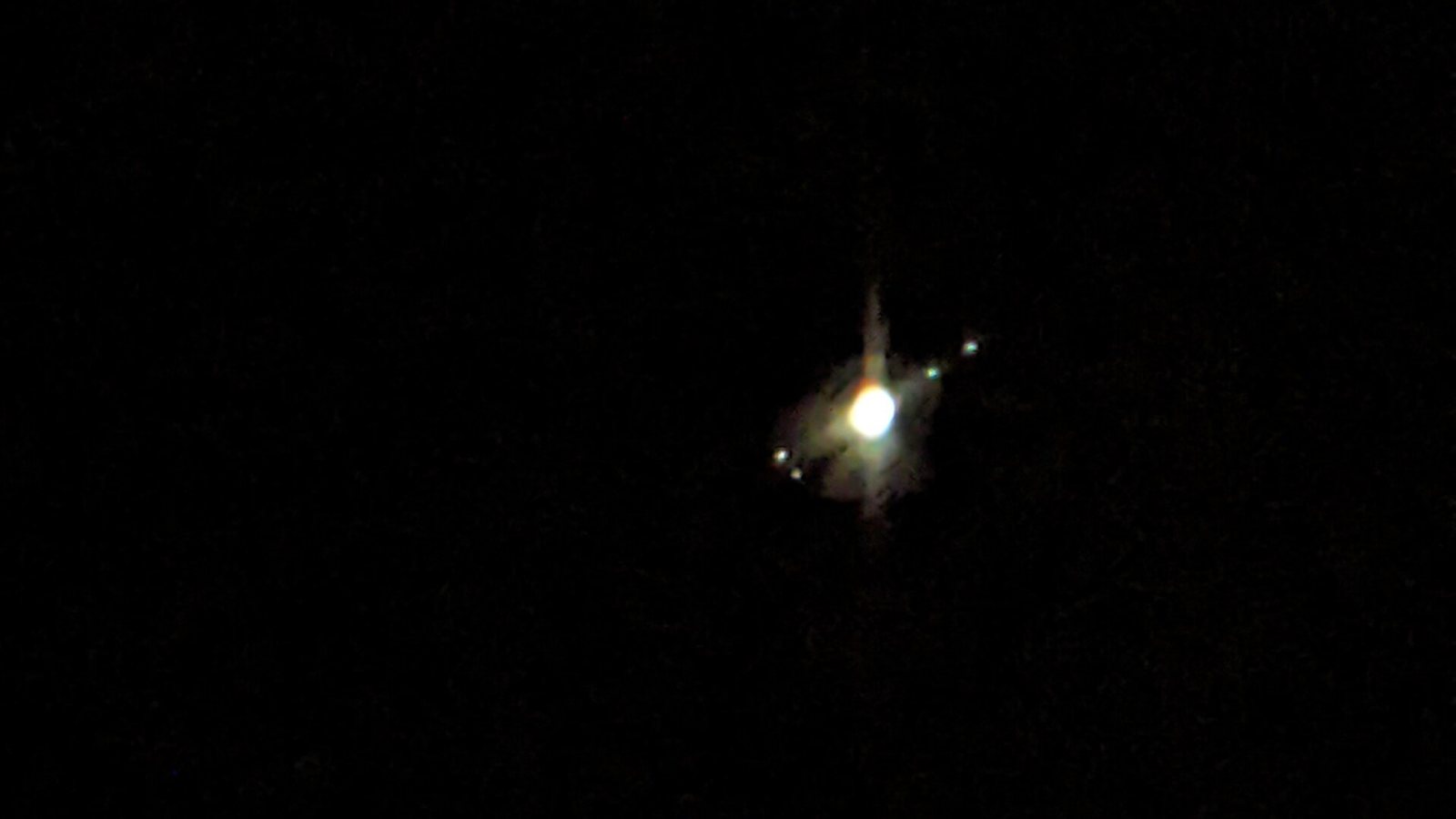

Venus is a morning object, past its January elongation and slowly getting closer to the Sun. It's 45° from the Sun on Feb 1 and 40° on Mar 1, with magnitude −4.0 fading to −3.8 and a gibbous disc shrinking from 19″ to 15″. It still rises 2–3 hours before the Sun. The crescent Moon passes 2.1° from it on Mar 4.
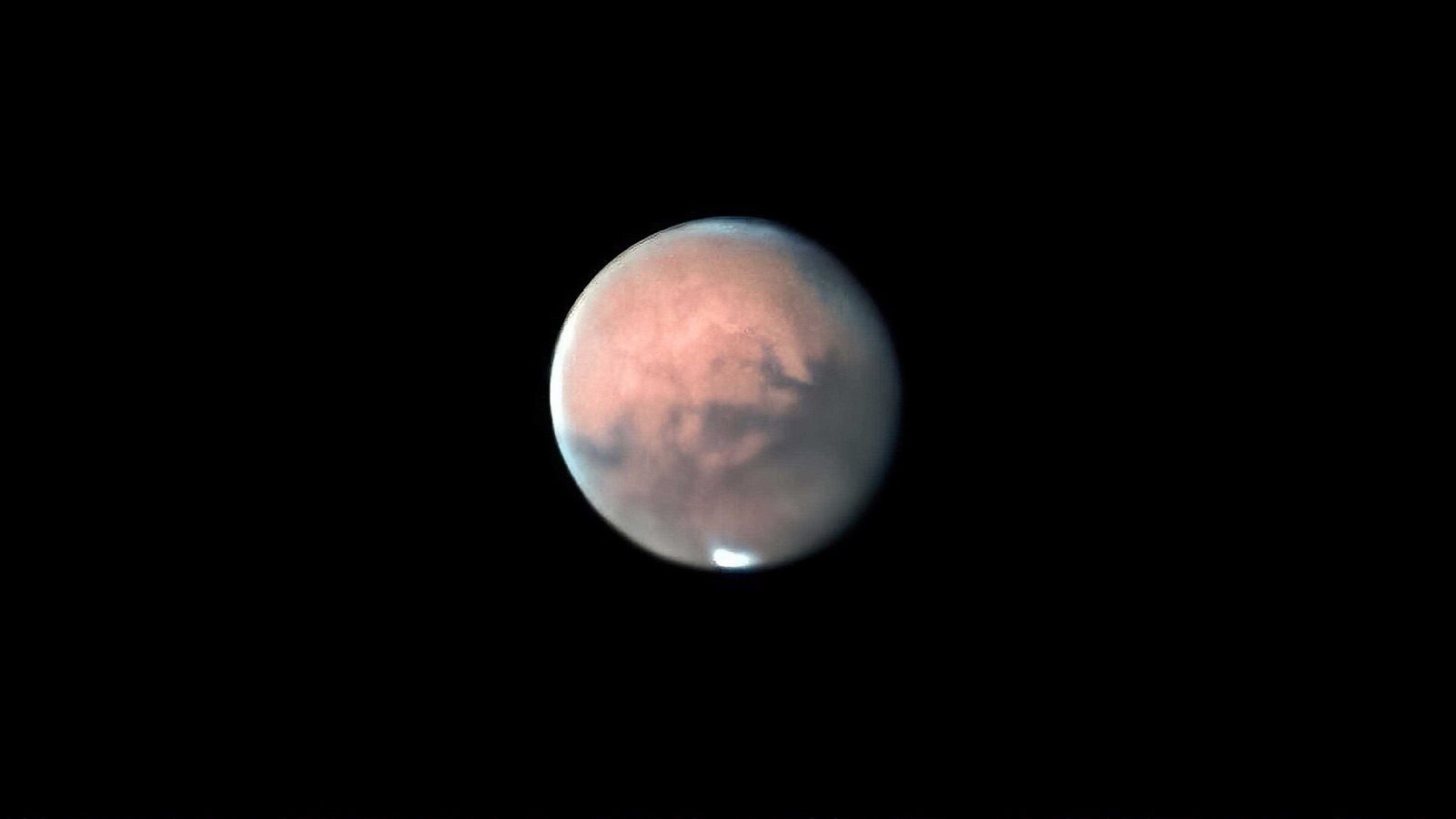
Mars reaches opposition on Feb 19 in Leo at magnitude −1.2. This is an aphelic opposition, with Mars near the far point of its orbit, so the disc is just 13.8″, compared with 25.7″ at a perihelic one. To the eye it's a bright orange star rising in the east at sunset. In a telescope the polar cap and dark markings need high power and steady air, and steady air is hard to get in February.
Jupiter is the planet to look at this month and, we'd say, this year. The 2027 Jupiter opposition is Feb 11 at 00:21 UTC in Leo, magnitude −2.5, 44.2″, 4.36 AU away. It rises at sunset, culminates around midnight at nearly 70° altitude from mid-northern latitudes, and sets at dawn. Any telescope shows the belts and the four Galilean moons. It stays about 9° west of Mars all month.
Saturn is on its way out. It's 58° east of the Sun on Feb 1 and 33° on Mar 1, at magnitude +1.2 on the Pisces–Cetus border, low in the west after dusk. It sets three hours after the Sun early in the month and under two by the end. Solar conjunction is Apr 7. Uranus (magnitude 5.7) is well placed in Taurus. Neptune, near Saturn, is lost in twilight by mid-month.
Meteor showers
No major shower peaks in February. The α-Centaurids peak around Feb 8 at a zenithal hourly rate near 6 from a radiant beside Hadar in Centaurus. It's a Southern Hemisphere shower, and the two-day-old Moon sets early, so the sky is dark for it. Northern observers get only sporadics, 5–10 an hour from a dark site. The next shower of note is the Lyrids on Apr 22–23, 2027, three days after full Moon.
Conjunctions and close approaches
Moon and Jupiter, Feb 20, 05:46 UTC, 1.2°. The 99 %-lit Moon passes just south of Jupiter on the night of Feb 19–20 for the Americas. From a strip of the south-east Pacific reaching Tierra del Fuego the Moon occults Jupiter between 03:51 and 06:01 UTC. Everywhere else it's a close pairing. Mars is about 5° further east, so all three fit a 50 mm frame. Expose for Jupiter and let the Moon overexpose, or bracket and blend (conjunction guide).
Moon and Regulus, Feb 20, 20:33 UTC, 1.5°. This is the same Moon the next evening for Europe and Africa. It rises between Regulus and Jupiter with the penumbral eclipse under way. Mars and Regulus, Feb 22, 3.8°. Mars is orange and Regulus is blue-white. Shoot the pair at 135–200 mm. The colour difference shows even on a phone screen.
February 2027 eclipses: annular solar and penumbral lunar
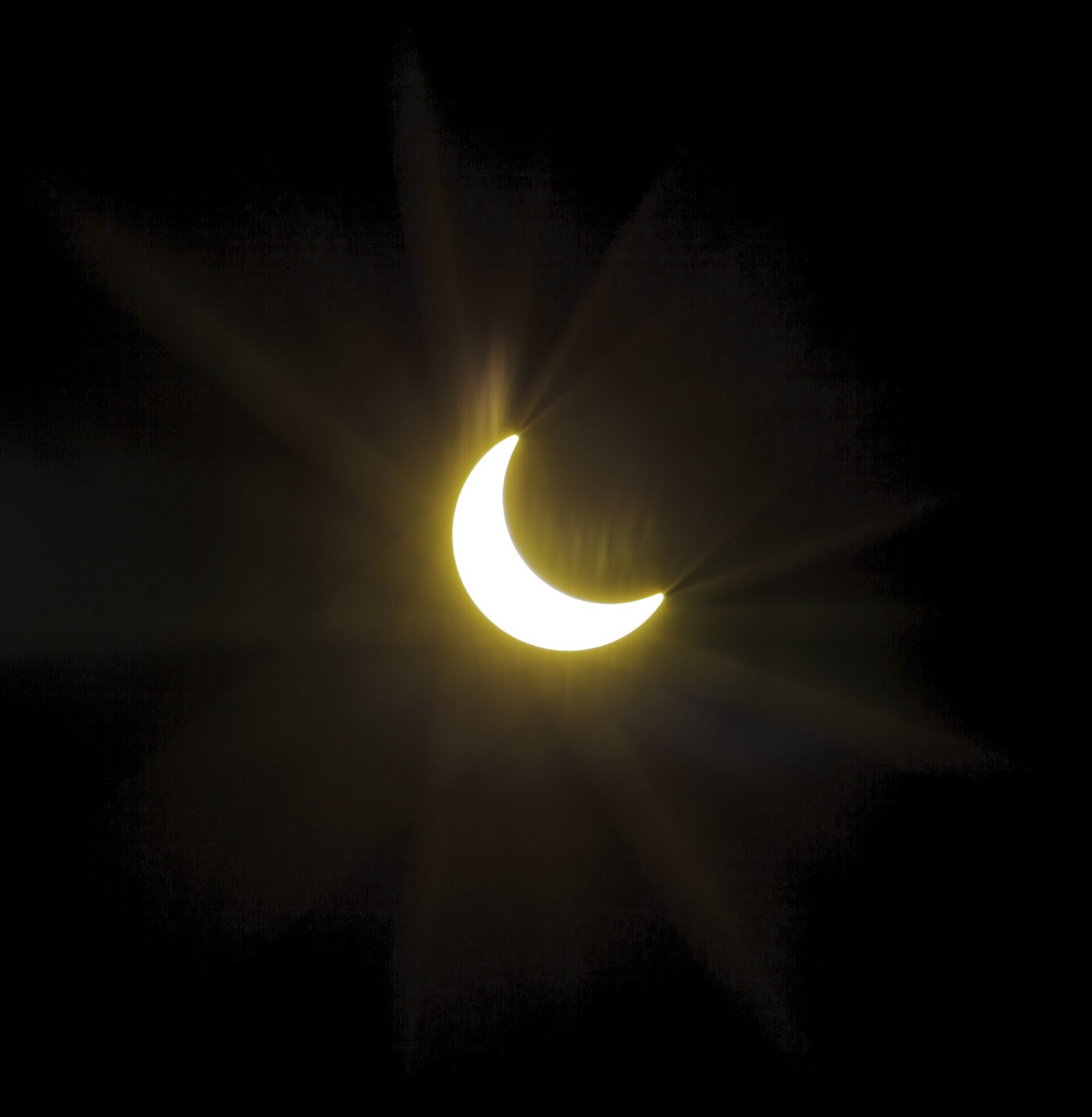
Annular solar eclipse, Feb 6. The Moon, three days past apogee, is too small to cover the Sun, so it leaves a ring. The path crosses Chile and Argentina into the South Atlantic. Greatest eclipse is at 16:00 UTC with 7 min 51 s of annularity. The longest ring, 7 min 53 s, falls at sea at 35°S, 53°W in a path about 175 miles wide. Magnitude is 0.928, so at most 86 % of the Sun is covered. The sky doesn't go dark, and you keep the filter on the whole time. A partial eclipse covers South America, Antarctica and west and southern Africa. Use certified solar film or glass on every lens and finder, and eclipse glasses for your eyes. The 2027 solar eclipse guide applies, except for the totality sequence.
.jpg)
Penumbral lunar eclipse, Feb 20. The full Moon passes through Earth's outer shadow only: P1 at 21:12 UTC, greatest at 23:13, P4 at 01:13 UTC on Feb 21, penumbral magnitude 0.927. It never touches the umbra, so there's no bite and no red. The southern limb goes slightly grey near maximum, and most people wouldn't notice unless told. It's visible wherever the Moon is up. Europe, Africa and South America see all of it, western North America sees it at moonrise and Asia at moonset. Shoot one frame at greatest eclipse and one an hour later at the same settings, because the shading only shows when you compare them (lunar eclipse guide).
Constellations and deep sky
At 22:00 local in mid-February from mid-northern latitudes, Orion is due south with the Orion Nebula (M42) below the belt. Sirius in Canis Major is at its highest, Gemini is overhead with the cluster M35, the Pleiades are high in the west, and Leo, with Jupiter and Mars in it, is well up in the east with the Beehive (M44) between them. The Double Cluster is still high in the northwest. For southern observers Sirius and Canopus are overhead, Carina and the Eta Carinae Nebula are high, and so are the Magellanic Clouds in the south.
The Milky Way core isn't visible from the north in February. The winter Milky Way is fainter but wide. It runs from Cassiopeia through Auriga, Gemini and Orion past Sirius, and it's a good wide-field target in the dark window. In the last days of the month the core clears the horizon before astronomical dawn from the Southern Hemisphere and the tropics. From mid-northern latitudes that doesn't happen until March. The zodiacal light is also back from about Feb 24. It's a broad tilted cone above the western horizon about 90 minutes after sunset, visible from dark sites from late February to early May. It's easy to mistake for light pollution the first time. Southern observers see it before dawn in the east.
Sun and twilight
The days get longer quickly. In London the Sun sets at 16:49 on Feb 1 and 17:38 on Feb 28, and sunrise moves from 07:39 to 06:48. That's 1 h 40 min more daylight over the month. Astronomical darkness shrinks from 18:44–05:43 (about 11 hours) on Feb 1 to 19:29–04:57 (9 h 28 min) on Feb 28. There are no daylight-saving changes this month. US clocks go forward Mar 14 and EU clocks Mar 28. ISS passes come in evening or morning runs depending on where you are, so check Sky Events.
What to photograph in February 2027
- The ring of fire, Feb 6. In the path: 400–600 mm, a certified filter, 1/500–1/2000 s at ISO 100 for the ring, and a bracketed sequence through the partial phases. Outside it, shoot the partial bite with a filtered telephoto. Solar eclipse guide.
- Jupiter and Mars at opposition, Feb 10–20. High-frame-rate video through a telescope around midnight, when both culminate, then stack the sharpest frames. For a wide shot, try Leo with both planets and Regulus over a landscape, 35–50 mm, 10–15 s. Planets guide.
- The Snow Moon rising with Jupiter, Feb 20. Put the Planner's Moon direction line through a landmark and shoot at moonrise, 200–400 mm, 1/125–1/250 s, ISO 200–400 while the low Moon is still dimmed. From the Americas Jupiter sits 1–2° away in the frame. Moon behind a landmark.

Every event above appears in Sky Events for your own location and time zone: both oppositions, the Moon–Jupiter and Moon–Regulus pairings, both eclipses with local contact times, and a reminder for each. Open the 360° sky and drag the time to Feb 20 to preview the Moon rising between Jupiter and Regulus where you stand.
FAQ
When is the full Moon in February 2027?
Feb 20, 2027 at 23:24 UTC, the Snow Moon. It's a penumbral lunar eclipse (21:12–01:13 UTC, greatest 23:13) that slightly shades the southern edge. It comes 40 hours after perigee, so some lists call it a supermoon. New Moon is Feb 6 at 15:56 UTC.
Is there a meteor shower in February 2027?
No major one. The α-Centaurids peak around Feb 8 at roughly 6 an hour and are a Southern Hemisphere shower. The next notable shower is the Lyrids on Apr 22–23, 2027, three days after full Moon.
Which planets are visible in February 2027?
Jupiter (opposition Feb 11, magnitude −2.5) and Mars (opposition Feb 19, −1.2) are up all night in Leo. Saturn is low in the west after dusk and sets earlier each evening. Venus is bright in the morning sky and slowly getting lower. Mercury is a low evening object in the first week only, then lost at inferior conjunction on Feb 18.
Sources and further reading
- Fred Espenak, Astropixels — Sky Events Almanac 2027 (GMT) (Moon phases, perigee/apogee, elongations, oppositions, Moon–planet separations, occultation flags).
- NASA GSFC — Solar Eclipses: 2021–2030 and Penumbral Lunar Eclipse of 2027 Feb 20 (eclipse times, magnitudes, durations, visibility regions).
- Fred Espenak, EclipseWise — Annular Solar Eclipse of 2027 Feb 06 (path, greatest duration, path width, obscuration).
- In-The-Sky.org — Jupiter at opposition, Mars at opposition and Lunar occultation of Jupiter (magnitudes, apparent sizes, constellations, occultation visibility map).
- timeanddate — Sunrise and sunset times in London, February 2027 (sunset, sunrise and twilight times).
- EarthSky — Zodiacal light: all you need to know (evening viewing season and method).