Sky calendar
What's in the Sky in March 2027: Moon, Planets, Meteors and What to Photograph
March 2027 is a month for evening planets. If you ask what's in the sky in March 2027, start with Jupiter and Mars. Both are still bright after their February oppositions. They share the Leo–Cancer border and close to 4.3° apart on the last night. The Moon passes both on March 19 (occulting Jupiter for Australia and New Zealand) before the Worm Moon on the 22nd, two days after the equinox. Venus is low at dawn with a thin crescent next to it on the 4th. There's no meteor shower, but the first two weeks are moonless in the evening. That's the time for the zodiacal light and the first pre-dawn look at the Milky Way core as it comes back.
At a glance
- Mar 4: Venus 2.1° north of the waning crescent Moon at 18:59 UTC. Low in the south-east before dawn, and a chance to find Venus in daylight.
- Mar 8: new Moon (09:29 UTC). Dark evenings Mar 1–14: zodiacal light in the west, galaxies overhead.
- Mar 19: Moon occults Jupiter (10:05 UTC) from Australia, New Zealand and the south-west Pacific. Everywhere else it's a close pairing with Jupiter and Mars.
- Mar 20: equinox at 20:25 UTC. Mar 22: Worm Moon at 10:44 UTC.
- Mar 31: Mars 4.3° north of Jupiter, magnitude −0.4 and −2.3, high in the evening sky.
What's in the sky in March 2027, night by night
Times are UTC, so convert to your local time. Separations are geocentric, and the Moon's parallax changes them by up to a degree depending on where you stand.
| Date (UTC) | Event | How to see it |
|---|---|---|
| Mar 4, 18:59 | Venus 2.1° N of the Moon | Pre-dawn, south-east. 12% crescent. Try for Venus after sunrise. |
| Mar 6, 05:28 | Mercury 1.2° N of the Moon | 4% crescent in dawn twilight. Use binoculars. |
| Mar 8, 09:29 | New Moon | Dark-sky nights either side. |
| Mar 13, 21:43 | Pleiades 1.1° S of the Moon | Evening, west. Crescent beside the cluster. |
| Mar 14 | US clocks forward (02:00 local) | Evening events shift an hour later on the clock. |
| Mar 15, 16:25 | First quarter Moon | Sets around midnight. The hours before dawn stay dark. |
| Mar 17, 07:00 | Mercury at greatest elongation, 27.6° W | Morning. Poor from the north, good from the south. |
| Mar 19, 04:31 | Moon at perigee, 227,695 mi | Not a supermoon. Full Moon is three days later. |
| Mar 19, 10:05 | Moon occults Jupiter (0.9° N geocentric) | Australia 07:54–09:51, New Zealand 09:11–10:42 UTC. Elsewhere a close pairing. |
| Mar 19, 18:33 | Mars 4.3° N of the Moon | Evening: Moon, Jupiter and Mars in one binocular field. |
| Mar 20, 06:13 | Regulus 1.5° N of the Moon | The gibbous Moon crosses the Sickle. |
| Mar 20, 20:25 | March equinox | Northern spring, southern autumn begin. |
| Mar 22, 10:44 | Full Moon (Worm Moon) | Rises at sunset, in Virgo. |
| Mar 27, 14:36 | Antares 0.3° N of the Moon | Pre-dawn, low in the south. |
| Mar 28 | EU clocks forward (01:00 UTC) | Sunset moves to after 19:30 in London. |
| Mar 30, 00:54 | Last quarter Moon | Evenings are dark again. |
| Mar 31, 06:00 | Mars 4.3° N of Jupiter | Evening, high in the south. Jupiter in Cancer, Mars below the Sickle. |
The March 2027 full Moon and the dark window
New Moon on March 8 (09:29 UTC), first quarter on the 15th (16:25), full on the 22nd (10:44), last quarter on the 30th (00:54). The full Moon is the Worm Moon. In 2027 it falls two days after the equinox, which makes it the first full Moon of northern spring and the Paschal full Moon that sets Easter for March 28. Perigee on the 19th at 227,695 miles is three days before full, so the Moon is slightly larger than average but it isn't a supermoon. Apogee falls on the 3rd (251,793 miles) and the 31st.
The dark window. Evenings are Moon-free from March 1 to about the 14th and again on the 30th–31st. Pre-dawn skies are dark from about the 6th to the 20th. For the Milky Way core, the useful mornings are March 8–20.
The Sun & Moon card gives Moon rise and set, phase and % illuminated for each night at your location, and Moon Details the distance. The Planner's timeline draws the Moon's altitude curve, so you can see at a glance that a night is "moonless until 2 am".
Planets visible in March 2027
Mercury is a morning object, at greatest western elongation (27.6°) on March 17. The morning ecliptic is at a shallow angle to the horizon around the northern spring equinox, so from mid-northern latitudes Mercury rises barely an hour before the Sun and is only a few degrees up in twilight. From the southern hemisphere, where this is autumn, it's one of the better morning showings of the year. Magnitude +0.3 mid-month, −0.1 by the 31st.
Venus is low in the south-east before dawn, magnitude −4.1 falling to −3.9, with elongation shrinking from 40° to 34° on the way to superior conjunction on August 12. On the 4th a 12% crescent Moon sits about 5° from it at dawn for the Americas and closes to 2.1° at 18:59 UTC, in daylight for Europe and Africa. Keep following the pair after sunrise and you can still see Venus with the naked eye, using the Moon to find it.
Mars, past its February 19 opposition, fades fast, from magnitude −1.2 on March 1 to −0.4 by the 31st, with the disc shrinking from 13.6″ to 11.3″. It's retrograding in Leo below the Sickle, high in the south by 10 pm. This is the last month for telescopic detail until 2029, so if you have a scope, use it now.
Jupiter is the bright one in the evening sky, at magnitude −2.5 to −2.3 with a disc of 44″ to 42″. It's also retrograding, and it moves from Leo back into Cancer around March 15 and ends the month beside the Beehive, culminating near 11 pm local time. Its February opposition is covered in the February 2027 sky guide.
Saturn (+0.8, Pisces) is lost in evening twilight by mid-month. Conjunction with the Sun is April 7, and it returns to the morning sky in May. Uranus (+5.8, Taurus) is an evening binocular object sinking in the west. Neptune is at conjunction on the 24th and not visible.
Meteor showers
March has no major shower. The next is the Lyrids, peaking around 01:00 UTC on April 23 with a ZHR of about 18, three days after the April 20 full Moon, so a waning gibbous will wash out all but the brightest. The Eta Aquariids in early May are the next dark-sky shower, best from the southern hemisphere. The meteor shower guide covers the routine.
Conjunctions and close approaches
- Mar 4, Moon–Venus, 2.1°, morning. A crescent with earthshine beside the brightest planet, 10–15° up in the south-east as civil twilight begins. Framing and exposure are in the conjunction guide.
- Mar 13, Moon–Pleiades, 1.1°, evening. A 30% crescent crossing the cluster in the west after dusk. Use 200–300 mm, then bracket Moon and stars and blend.
- Mar 18–19, Moon–Jupiter–Mars, evening. On the evening of the 18th (Americas, Europe) the gibbous Moon approaches Jupiter. By the evening of the 19th it has passed it and sits 4° from Mars, all three in a 7° field. From eastern Australia and New Zealand the Moon occults Jupiter on the evening of the 19th local time, about an hour from disappearance to reappearance.
- Mar 27, Moon–Antares, 0.3°, pre-dawn. A waning gibbous almost touching the red supergiant, low in the south.
- Mar 31, Mars–Jupiter, 4.3°, evening. The planet pairing of the month, high in the south at nightfall, with the Beehive next to Jupiter. A 135–200 mm lens fits all three. The planets guide covers the view through a telescope.
Constellations, galaxies and the Milky Way's return
At 10 pm mid-month from 40° N, Leo is high in the south-east with Jupiter and Mars at its western edge, Cancer and the Beehive (M44) above them and Gemini overhead. Orion is sinking in the south-west, so this is the last hour for M42. Ursa Major is high in the north-east and Virgo rising in the east. Galaxy season has started. The Leo Triplet, M81 and M82, M51 and, by the small hours, the Virgo cluster are all up. They need the March 1–14 dark window and a telescope or 300 mm-plus lens. From the southern hemisphere the evening sky is the best of the year, with Canis Major overhead, Carina and the Eta Carinae Nebula, and Crux rising in the south-east.
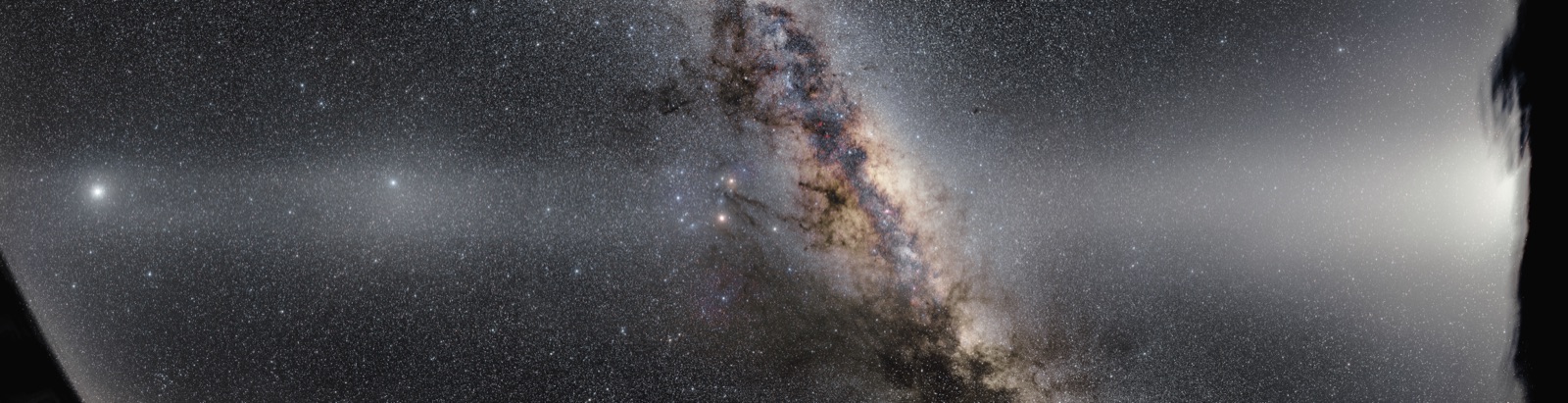
The Milky Way. The core is back. From mid-northern latitudes the galactic centre rises around 2–3 am local time in late March and stands 15–20° up in the south-east as astronomical twilight begins. The band runs along the eastern horizon as a long low arch, and that shape suits a panorama rather than a single frame. The best mornings are March 8–20, and the Milky Way guide covers the hour-by-hour plan. You'll be up at 3 am in the cold and the core will still be low, but it's the first arch of the season.
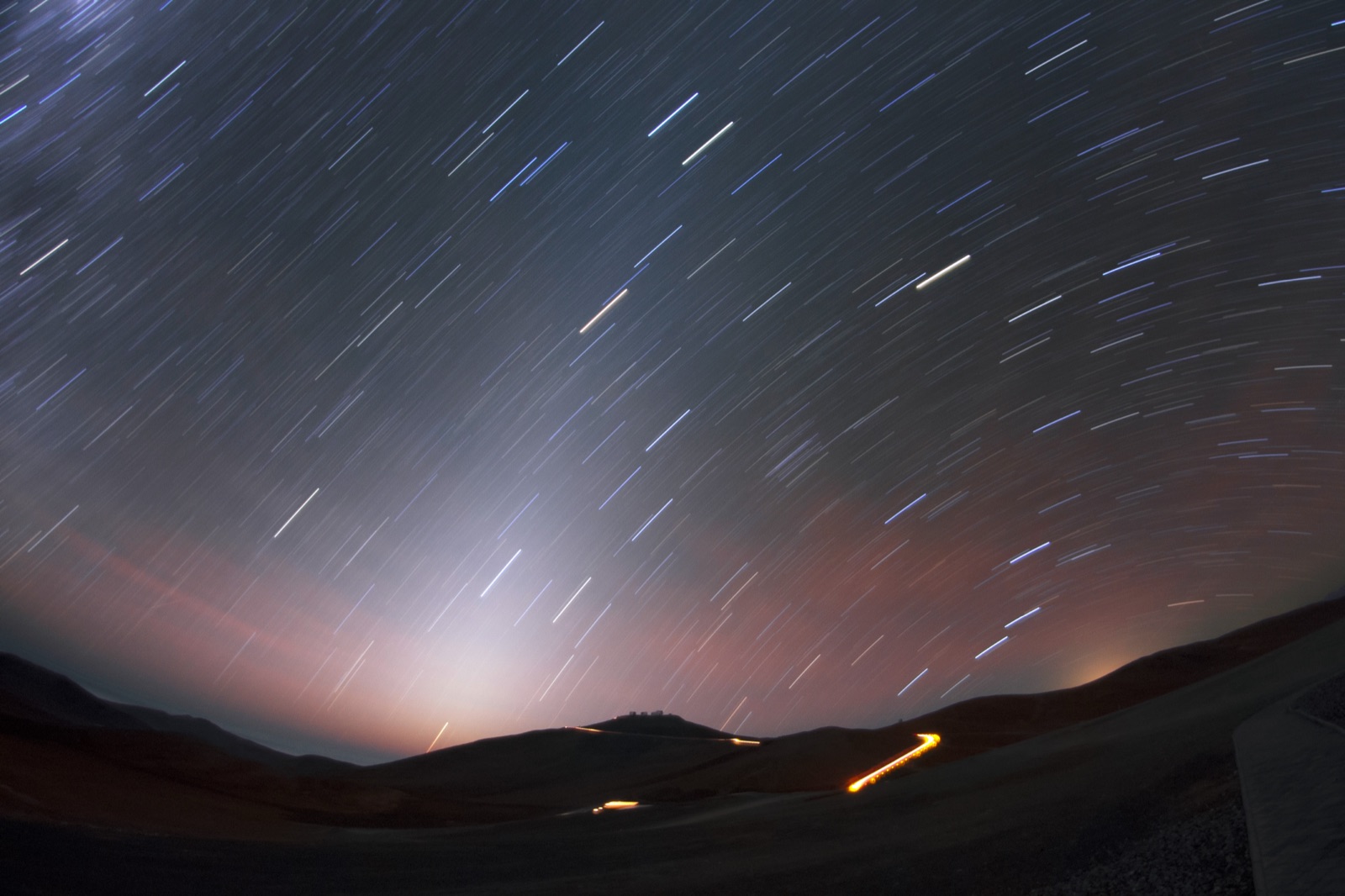
Zodiacal light. This is the best time of year for it in the north. From late February to early May the ecliptic makes a steep angle with the western horizon after dusk. On moonless nights the zodiacal light shows as a faint pyramid reaching past the Pleiades about 90 minutes after sunset, and you can see it for an hour. Look on March 1–14 from a dark site.
Sun, twilight and the March 2027 equinox
The days get longer quickly around the equinox. In New York the Sun sets at 17:47 EST on March 1 and 19:20 EDT on March 31, and astronomical night shrinks from about 9¾ hours to just over 8. In London sunset moves from 17:40 GMT to 19:32 BST, and full darkness from about 9½ hours to just over 7. Clocks go forward in the United States on Sunday March 14 and in the EU and UK on Sunday March 28, so for two weeks the transatlantic offset is an hour narrower than usual. ISS passes come in evening or morning runs that depend on your latitude. Check Sky Events for the current run and the ISS guide for the method.
What to photograph in March 2027
- Venus and the crescent Moon, March 4 at dawn. You get earthshine, Venus 5° away and a sky going from blue to orange. Then stay for the daylight shot of Venus as a white point beside the Moon in a blue sky. The Venus guide explains the daytime search.
- The Milky Way arch, any morning March 8–20. This is the first one of the season. Shoot a low panorama from the south-east, with the core at one end and Cygnus at the other, between 3 am and astronomical twilight. See the panorama guide and the NPF rule.
- Moon, Jupiter and Mars, evening of March 19. The near-full Moon and two bright planets in one 7° field at 135–200 mm. Expose for the planets and blend a short Moon frame. The group rises at sunset, so the first hour has it low over a horizon, and the Moon-behind-a-landmark guide shows how to put a foreground under it.
Sky Events lists every item on this page for your own location in local time, with reminders: conjunctions with their separation at your spot, the Mercury elongation, the March 19 occultation if you're in its path. Drag the time in the 360° sky to the evening of March 31 to see how high Jupiter and Mars will stand, and use the Planner's field-of-view overlay to check that your lens fits the pair with the Beehive.
FAQ
When is the full Moon in March 2027?
March 22, 2027 at 10:44 UTC, the Worm Moon, the first full Moon of northern spring. It rises around sunset that evening in Virgo. It isn't a supermoon, because perigee was three days earlier.
Is there a meteor shower in March 2027?
No major shower peaks in March. The next is the Lyrids on April 22–23, 2027, ZHR about 18, but a bright waning gibbous Moon will wash out most of it. The Eta Aquariids in early May are the next dark-sky shower.
Which planets are visible in March 2027?
Jupiter (−2.4) and Mars (−1.2 fading to −0.4) all evening on the Leo–Cancer border, 4.3° apart on March 31. Venus (−4.0) low in the south-east before dawn, with Mercury below it around its March 17 elongation. Saturn is lost in evening twilight by mid-month.
Where is the Moon occultation of Jupiter visible on March 19, 2027?
From Australia, New Zealand, Tasmania, New Caledonia and southern Papua New Guinea, between about 07:54 and 10:42 UTC, which is the evening of the 19th local time. Everywhere else it's a close pairing of a few degrees.
Sources and further reading
- Fred Espenak, Astropixels — Sky Event Almanac 2027 (GMT) (Moon phases, apogee/perigee, conjunction dates and separations, Mercury elongation, equinox, Saturn and Neptune conjunctions).
- US Naval Observatory — Phases of the Moon and Rise/Set tables (phase times cross-checked; New York and London sunrise/sunset).
- NASA JPL — Horizons ephemeris (planet magnitudes, disc sizes, elongations and constellations through the month).
- Dominic Ford, In-The-Sky.org — Lunar occultation of Jupiter, 19 March 2027 (visibility regions and UTC spans).
- EarthSky — Zodiacal light on spring evenings and The Lyrid meteor shower in 2027.
- timeanddate — Daylight Saving Time 2027 in the United States and March: Worm Moon.