Sky calendar
What's in the Sky in June 2027: Moon, Planets, Meteors and What to Photograph
June 2027 is the month of the shortest nights. If you ask what's in the sky in June 2027, start with the time you have. The solstice is on June 21 at 14:11 UTC, and north of about 48.5° N the sky never gets fully dark around that date. Jupiter and Mars are in the west after sunset, with the crescent Moon passing both on June 8–10. The Milky Way core is up from the end of twilight and highest around 1 am, and the first nine nights of the month are Moon-free. From 50° N and further north, look for noctilucent clouds low in the north. The Strawberry Moon is full on the evening of June 18 in the Americas, and it's the lowest full Moon of the year. There's no eclipse this month. The next one is the total solar eclipse of August 2.
At a glance
- Jun 4: new Moon (19:40 UTC). Moon-free nights June 1–9 for the Milky Way core.
- Jun 8–10: the Moon passes Jupiter, Regulus and Mars in the west after sunset. Closest to Jupiter at 10:54 UTC on the 9th (1.9°).
- Jun 17: Moon occults Antares for Australia, Indonesia and the south-west Pacific. Elsewhere the two are a few degrees apart.
- Jun 19: Strawberry Moon at 00:44 UTC, which is 8:44 pm EDT and 5:44 pm PDT on June 18.
- Jun 21: solstice at 14:11 UTC (10:11 am EDT, 7:11 am PDT). No astronomical darkness north of about 48.5° N.
What's in the sky in June 2027, night by night
Times are UTC, so convert to your local time. Events after about 19:00 UTC fall on the previous calendar evening in the Americas. Separations are geocentric, and the Moon's parallax changes them by up to a degree depending on where you stand.
| Date (UTC) | Event | How to see it |
|---|---|---|
| Jun 1, 12:06 | Saturn 7.7° S of the Moon | Pre-dawn, east. 14% crescent about 6–7° from Saturn. |
| Jun 1–10 | Mercury in the evening sky | Low in the west-north-west after sunset. Magnitude 0.9 fading to 2.3. |
| Jun 4, 19:40 | New Moon | Dark nights from the 1st to about the 9th. |
| Jun 6, 06:29 | Mercury 2.7° S of the Moon | Evening of the 5th in the Americas: a 2% crescent about 5° from Mercury, 5° up. Use binoculars. |
| Jun 6, 14:54 | Moon at perigee, 224,752 mi | Two days after new Moon. No visible effect. |
| Jun 9, 10:54 | Jupiter 1.9° N of the Moon | Evening of the 8th (Americas, Europe): crescent 6–8° from Jupiter. Evening of the 9th in Australia and East Asia: 2–3°. |
| Jun 10, 01:41 | Regulus 2.2° N of the Moon | Evening of the 9th (Americas, Europe): the crescent about 3° from Regulus. |
| Jun 10, 22:45 | Mars 3.9° N of the Moon | Evening of the 10th, west: half-lit Moon 4–5° from Mars. |
| Jun 11, 10:56 | First quarter Moon | Sets around 1 am. The hours before dawn stay dark. |
| Jun 11, 21:55 | Possible γ-Delphinid display | A prediction, not a known shower. Best placed for Europe and Africa. |
| Jun 14, 01:44 | Spica 3.0° N of the Moon | Evening of the 13th (Americas), south. |
| Jun 16 | Venus 4.7° N of Aldebaran | Dawn, very low in the east-north-east. Binoculars. |
| Jun 17, about 14:30 | Moon occults Antares | Australia, Indonesia, Papua New Guinea, Malaysia, New Caledonia and Fiji. Elsewhere 4–6° apart. |
| Jun 19, 00:44 | Full Moon (Strawberry Moon) | Rises 12–13 minutes after sunset on June 18 in New York, Los Angeles and London. |
| Jun 21, 14:11 | June solstice | Northern summer and southern winter begin. |
| Jun 22, 05:08 | Moon at apogee, 252,089 mi | The full Moon three days earlier is smaller than average. |
| Jun 22 | June Boötids, possible peak | Usually a few meteors an hour. Waning gibbous Moon. |
| Jun 23 | Mercury at inferior conjunction | Not visible. |
| Jun 27, 04:54 | Last quarter Moon | Rises around 12:30 am. Evenings are dark again. |
| Jun 29, 01:32 | Saturn 8.0° S of the Moon | Pre-dawn on the 28th and 29th, east, 9–10° apart. |
The June 2027 full Moon and the dark window
New Moon on June 4 (19:40 UTC), first quarter on the 11th (10:56), full on the 19th (00:44), last quarter on the 27th (04:54). The full Moon is the Strawberry Moon. In the Americas it's full on the evening of June 18, at 8:44 pm EDT or 5:44 pm PDT. It rises about 12 minutes after sunset that evening in New York (20:42 EDT) and Los Angeles (20:20 PDT), and in London it rises at 21:34 BST, 13 minutes after sunset. The full Moon sits opposite the Sun, so near the June solstice it's far south in the sky. This one is in Sagittarius at declination −27°, and from 40° N it climbs only about 23° above the southern horizon. That makes it the lowest full Moon of the year. It's also near apogee, which falls on the 22nd at 252,089 miles, so the Moon is slightly smaller than average. Perigee is on the 6th at 224,752 miles, two days after new Moon.
The dark window. Nights are Moon-free from June 1 to about the 9th. After that the waxing Moon sets later each night, and from about the 15th to the 21st it's up for nearly all of the short northern night. After full Moon the hours between the end of twilight and moonrise are dark again. That window is short from about the 22nd, and by the 27th the Moon rises around 12:30 am. For the Milky Way core, which is highest around 1 am, the best nights are June 1–9 and then from about June 26.
Moon Details gives Moon rise and set, phase and % illuminated for each night at your location. Best Milky Way nights scores the next 45 nights on darkness, Moon, core altitude and cloud, so from late April it covers the June dark window.
Planets visible in June 2027
Mercury is an evening object in the first ten days. Greatest eastern elongation was on May 28 (22.9°). On June 1 it's magnitude 0.9 and about 10° up in the west-north-west 40 minutes after sunset from 40° N. By the 10th it has faded to 2.3 and is only 4° up. It reaches inferior conjunction on the 23rd.
Venus is in the morning sky but very low, heading for superior conjunction in mid-August. It's magnitude −3.9 all month. From 40° N it rises only 50–57 minutes before the Sun and is about 4° up half an hour before sunrise. It passes 5° from the Pleiades on the 8th, 0.7° from Uranus on the 14th and 4.7° from Aldebaran on the 16th, all in bright twilight, so use binoculars and stop as soon as the Sun is close to rising. From the southern hemisphere Venus rises about 95 minutes before the Sun on June 1, so it's easier to see there early in the month.
Mars is in Leo in the western evening sky, at magnitude 0.8 on June 1 and 1.1 by the 30th. Its disc is only 7″ to 6″ across, too small for detail in most telescopes. From New York, Mars sets at about 1:30 am EDT early in the month and around midnight by the end.
Jupiter is the brightest planet in the evening sky, magnitude −1.9 to −1.8, also in Leo and west of Mars. Regulus sits between the two. Mars moves east away from Jupiter, and the gap grows from 17° on June 1 to 27° on June 30. From 40° N, Jupiter is about 40° up in the west 45 minutes after sunset on June 1 and 20° up by the end of the month, when it sets around 11 pm. Its disc shrinks from 35″ to 33″. It reaches conjunction with the Sun in late August.
Saturn (+0.7, Pisces) is a morning planet. From New York it rises around 3:20 am EDT on June 1 and 1:30 am by the 30th, and stands 17–37° up in the east as the sky brightens. The crescent Moon is 6–7° from it at dawn on June 1 and 9–10° from it on the mornings of the 28th and 29th. Its opposition is in October. Uranus was at conjunction on May 27 and is lost in dawn twilight. Neptune (+7.8, Pisces) is in the morning sky near Saturn, and you need a telescope and a chart to find it.
Meteor showers
June has no major shower. The International Meteor Organization's 2027 calendar lists three items. The June Boötids are active June 22 to July 2, and recent video data put the 2027 maximum on June 22, three days after full Moon. The radiant in northern Boötes is high in the evening. Most years give only a few meteors an hour, though there were strong displays in 1998 and 2004. The Daytime Arietids peak on June 8. They're the strongest daytime shower, but the radiant is close to the Sun, so radio and radar detect them and the eye sees very few. A possible γ-Delphinid display is predicted for June 11 at 21:55 UTC. It's based on one model, and nothing was seen at a similar encounter in 2013, so it may not happen. The next major showers are the Southern Delta Aquariids, peaking on July 31, and the Perseids, peaking on August 13. The meteor shower guide covers the routine.
Conjunctions and close approaches
- Jun 8–10, Moon–Jupiter–Regulus–Mars, evening. On the 8th, from the Americas and Europe, a 22–24% crescent sits 6–8° from Jupiter, 20–30° up in the west at dusk. On the 9th it's about 3° from Regulus, with Jupiter lower toward the horizon and Mars higher up. On the 10th the half-lit Moon is 4–5° from Mars. From Australia and East Asia the Moon is 2–3° from Jupiter on the evening of the 9th. Framing and exposure are in the conjunction guide.
- Jun 13, Moon–Spica, 3.0°, evening. A gibbous Moon about 3–4° from Spica in the south-west after dusk.
- Jun 16, Venus–Aldebaran, 4.7°, dawn. Both very low in bright twilight from the north. A binocular target only.
- Jun 17, Moon–Antares, evening (occultation in the south-west Pacific). From Australia the 98%-lit Moon covers Antares for about an hour on the night of June 17–18 local time. Approximate times: Perth 9:40–10:55 pm AWST on the 17th, Darwin 11:45 pm–12:50 am ACST, Adelaide 12:05–1:10 am ACST, Melbourne 12:55–1:40 am AEST, Sydney 1:00–2:00 am AEST and Brisbane 1:00–2:15 am AEST on the 18th. Tasmania and New Zealand are just outside the path. Jakarta, Singapore, Kuala Lumpur, Port Moresby, Nouméa and Suva also see it. In the Americas the Moon is about 6° from Antares on the evenings of the 16th and 17th, and in Europe about 4° on the 17th. Check a local prediction before you set up, because times change by minutes over short distances.
- Jun 28–29, Moon–Saturn, 9–10°, pre-dawn. A thick waning crescent above Saturn in the east. A 50 mm frame fits both. The planets guide covers the view through a telescope.

Constellations, the Milky Way core and noctilucent clouds
At 11 pm in mid-June from 40° N, Arcturus in Boötes is high in the south-west and Vega high in the east, with Hercules between them and the globular cluster M13 nearly overhead. Scorpius and Antares are low in the south, with Sagittarius rising behind. The Big Dipper is in the north-west, and Leo, with Jupiter and Mars, is setting in the west. The Summer Triangle of Vega, Deneb and Altair is up in the east. From the southern hemisphere June nights are the longest of the year. Scorpius and Sagittarius pass close to overhead, Crux and the Pointers are high in the south-west, and Omega Centauri is high after dark.
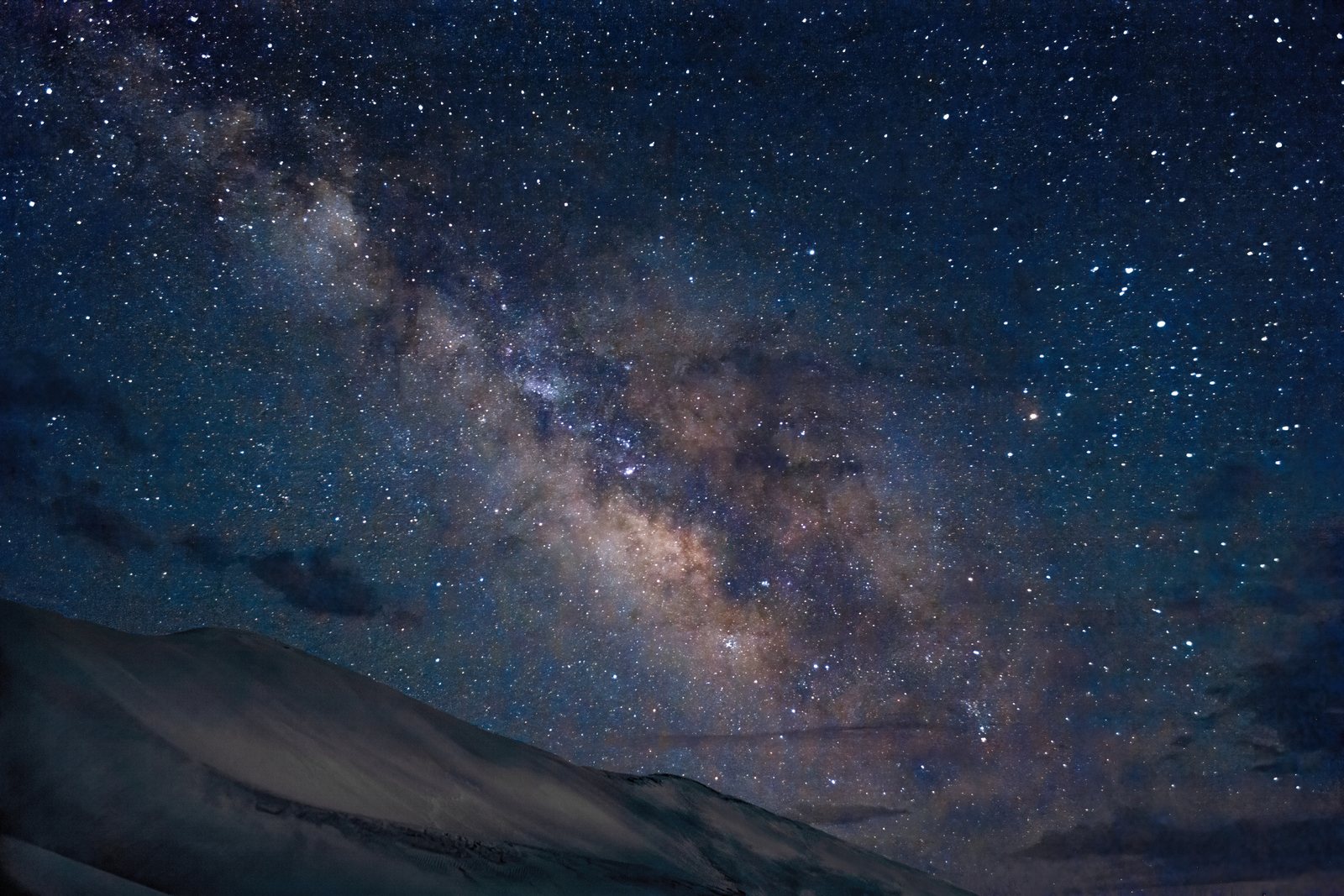
The Milky Way core. In mid-June the galactic centre rises in the south-east at about 9 pm local daylight time and is due south at about 1:10 am EDT (2:05 am on June 1, 12:10 am on June 30). From 40° N it reaches only 21° above the horizon. From 30° N it reaches 31°, from 50° N only 11°, and from 30° S it passes almost overhead. The constraint in the north is darkness, not altitude. The core is up for the whole of the short night, so every Moon-free hour counts. The best nights are June 1–9, then from about June 26 before moonrise. The Milky Way guide covers the hour-by-hour plan and the panorama guide covers the arch.
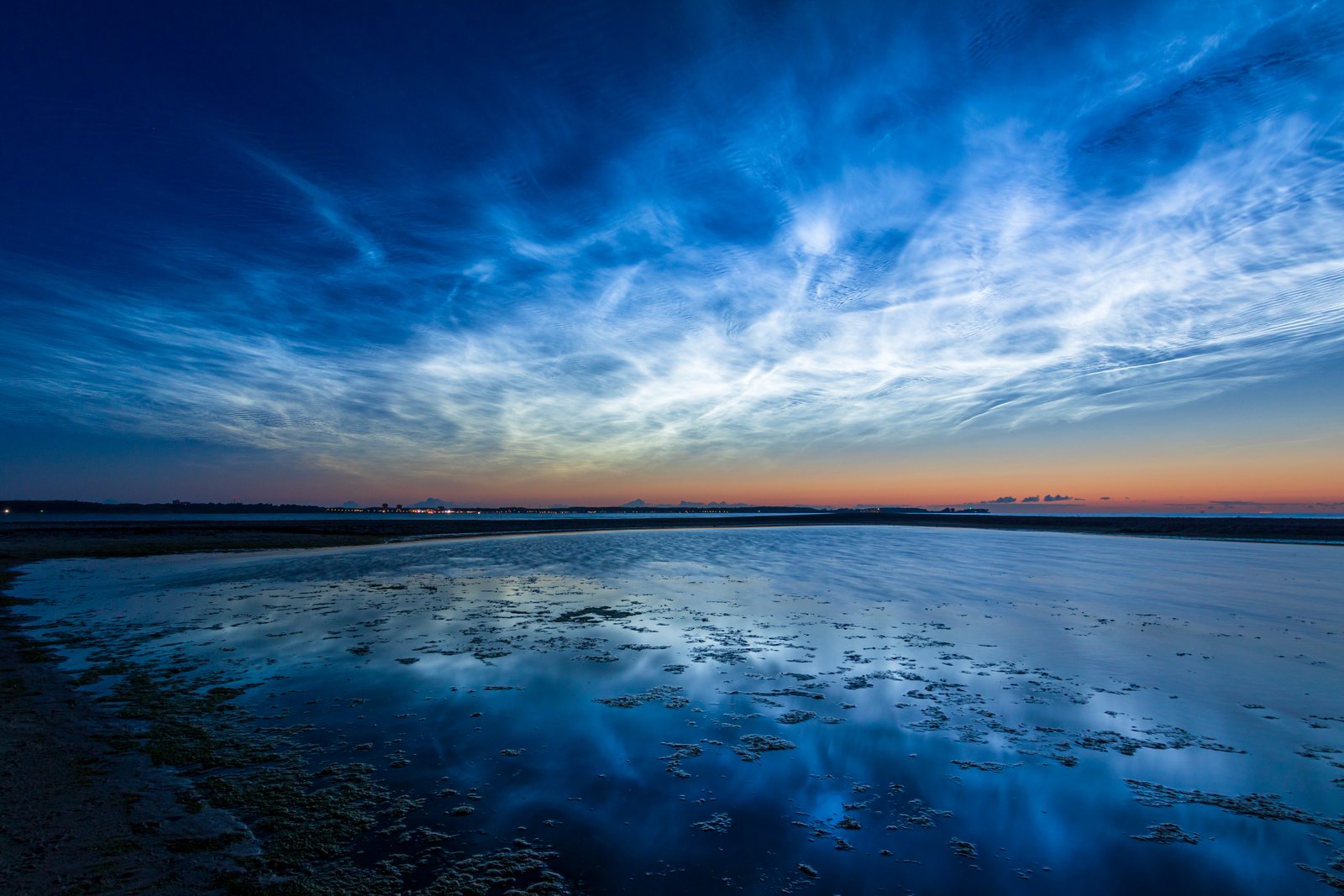
Noctilucent clouds. These are the highest clouds on Earth, thin ice clouds about 51 miles (82 km) up. In the northern hemisphere they appear from late May to early August. They show only in twilight, when the Sun is between about 6° and 16° below the horizon, so the ground is dark but the clouds are still in sunlight. Look low in the north-west to north from about an hour after sunset, or in the north to north-east before dawn. They look like blue-white streaks and ripples, brighter than the twilight around them. The UK's NERC MST radar facility says they're seen almost every night above 65° N, are rare south of 53° N and are exceptional south of 50° N. Because they're so high, you can see clouds that lie up to about 500 miles further north, low on your horizon. That covers Scotland, northern England, Scandinavia, the Baltic, Canada and, rarely, the northern US states. They're not visible from the southern hemisphere in June. Their season there is the southern summer.

Sun, twilight and the June 2027 solstice
The June solstice is on June 21 at 14:11 UTC, which is 10:11 am EDT, 7:11 am PDT and 3:11 pm BST. In New York the Sun rises at 05:25 EDT and sets at 20:31, 15 hours 6 minutes of daylight. In London it rises at 04:43 BST and sets at 21:21, 16 hours 38 minutes. The earliest sunrise and latest sunset don't fall on the solstice. In New York the earliest sunrise is on June 14 and the latest sunset on June 28, and in London they're on June 17 and June 25.
How much true darkness there is. Astronomical night begins when the Sun is 18° below the horizon. At the solstice the Sun's lowest point at local midnight is 90° minus your latitude minus 23.4°. So north of about 48.5° N it never gets 18° down, and the darkest part of the night is still astronomical twilight. The table shows the night of June 21–22.
| Latitude | Examples | Astronomical darkness | Sun's lowest point |
|---|---|---|---|
| 30° N | Houston, Cairo | 6 h 44 min in Houston (22:01–04:45 CDT) | 37° below |
| 40° N | New York, Denver, Madrid | 4 h 41 min in New York (22:37–03:18 EDT) | 27° below |
| 45° N | Minneapolis, Montreal, Milan | 3 h 17 min in Minneapolis (23:36–02:53 CDT) | 22° below |
| 47.6° N | Seattle | 1 h 44 min in Seattle (00:19–02:03 PDT) | 19° below |
| 50° N | Calgary, Frankfurt, Prague | None. Astronomical twilight all night. | 16.6° below |
| 55° N | Edinburgh, Copenhagen, Moscow | None. Nautical twilight all night. | 11.6° below |
The gap without full darkness lasts longer the further north you are. In Paris (48.9° N) it runs only from about June 12 to 29. In London it's from about May 23 to July 20, and in Edinburgh from early May to early August. The twilight guide explains the three stages. In the southern hemisphere this is the winter solstice, and Sydney gets about 11 hours of astronomical darkness.
Eclipses. There's no eclipse in June 2027. The next is the total solar eclipse of Monday, August 2, 2027, across southern Spain, Gibraltar, North Africa, Egypt, Saudi Arabia and Yemen, with up to 6 min 23 s of totality near Luxor. It can't be seen from the United States. If you plan to travel, book now and read the August 2, 2027 solar eclipse guide. The penumbral lunar eclipse on July 18 is too slight to see.


What to photograph in June 2027
- Moon, Jupiter and Regulus, June 8–9 at dusk. A thin crescent with earthshine and Jupiter low in the west, 45–60 minutes after sunset. Shoot at 70–135 mm to fit the Moon and Jupiter, and put a skyline under them. Expose for the twilight and the planet, then blend a short frame for the Moon. The Moon-behind-a-landmark guide shows how to plan the foreground.
- The Milky Way core, June 1–9. From 30–45° N the core is low in the south around 1 am. Use a 14–24 mm lens, the widest aperture you have and an exposure set by the NPF rule, and frame a foreground below it. Check that your night has full darkness first. North of 48.5° N it doesn't at this time of year.
- Noctilucent clouds, any clear night from 50° N and further north. Watch the north-west from an hour after sunset with a clear low horizon. Start at 24–50 mm, f/2.8, ISO 400–800 and 2–4 s, and adjust as the sky darkens. A sequence of frames shows the ripples moving. The timelapse guide covers the interval and exposure.
Sky Events (Planner, then the search button, then Sky Events) lists events for your own location in local time. The Moon–Jupiter and Moon–Mars pairings are under the Planets filter, with the separation, time of closest approach, altitude and direction. Tap an event to open it in the Planner at that time. Still Dark doesn't compute occultations, so for the June 17 occultation of Antares, check an occultation map such as those from IOTA (the International Occultation Timing Association). For a reminder, save the event as a plan and add reminders to the plan. All Twilights shows every twilight window for your location and says when there's no full darkness. For noctilucent clouds you need a clear northern horizon, and the Planner's weather timeline shows hourly cloud layers (Pro).
FAQ
When is the full Moon in June 2027?
June 19, 2027 at 00:44 UTC, which is 8:44 pm EDT and 5:44 pm PDT on June 18. It's the Strawberry Moon. It rises around sunset on June 18 in the Americas and Europe. It stays low all night, because it's the lowest full Moon of the year. It isn't a supermoon, because apogee falls three days later.
When is the summer solstice in 2027?
June 21, 2027 at 14:11 UTC, which is 10:11 am EDT, 7:11 am PDT and 3:11 pm BST. It's the longest day of the year in the northern hemisphere and the shortest in the southern.
Does it get fully dark in June?
It depends on your latitude. Around the solstice there's no astronomical darkness north of about 48.5° N. That includes London, Paris, Calgary and everything further north. New York gets about 4 h 40 min and Houston about 6 h 45 min. Seattle gets under 2 hours.
Which planets are visible in June 2027?
Jupiter (−1.9) and Mars (+0.8 to +1.1) are in Leo in the western evening sky, and Jupiter sets around 11 pm by the end of the month. Saturn (+0.7) is in the east before dawn. Mercury is low in the evening for the first ten days. Venus is very low at dawn.
Is there an eclipse in June 2027?
No. The next is the total solar eclipse of August 2, 2027, visible from southern Spain, North Africa and the Middle East but not from the United States.
Sources and further reading
- US Naval Observatory — Phases of the Moon, Earth's Seasons and Sun and Moon data for one day (Moon phases, solstice time, New York, Los Angeles and London sunrise, sunset and moonrise).
- Fred Espenak, Astropixels — Sky Event Almanac 2027 (GMT) (Moon–planet conjunctions, perigee and apogee, Mercury elongation and inferior conjunction, Venus–Aldebaran).
- NASA GSFC — Solar Eclipses: 2021–2030 and Lunar Eclipses: 2021–2030 (no eclipse in June 2027).
- International Meteor Organization — Meteor Shower Calendar 2027 (June Boötids, Daytime Arietids, γ-Delphinids, Perseids).
- NERC MST Radar Facility — Noctilucent clouds: where and when can they be seen (height, Sun angle, latitudes and season).
- Met Office — Noctilucent clouds (when to look and latitude range).
- NASA JPL — Horizons ephemeris and the DE440 ephemeris used to compute planet magnitudes, rise and set times, twilight lengths by latitude, Milky Way core altitudes and the Antares occultation times.