Sky calendar
What's in the Sky in January 2027: Moon, Planets, Meteors and What to Photograph
If you want to know what's in the sky in January 2027, start with the first four days. Three events fall within 24 hours. Earth is at perihelion and Venus is at its greatest morning elongation on January 3, and the Quadrantids peak before dawn on January 4 with only a thin crescent Moon in the sky. After that, Jupiter is up all night in Leo, a month before opposition, and Mars is getting brighter next to it. The Wolf Moon on January 22 is the closest full Moon of 2027. If you photograph one thing this month, make it the Quadrantids from a dark site. Times below are UTC, so convert to your local time.
At a glance
- Jan 3–4: Quadrantids. Peak predicted for 04–06 UTC on January 4, ZHR up to 120, a six-hour window. The waning crescent (about 13% lit) doesn't interfere.
- Jan 3: Venus at greatest western elongation, 47° from the Sun, magnitude −4.4. This is when the morning star is highest before dawn.
- Jan 3: Earth at perihelion, 91.40 million miles from the Sun at 02:32 UTC.
- Jan 22, 12:17 UTC: Wolf Moon. The closest full Moon of 2027, 222,230 miles, 14 hours after perigee.
- Jan 23–24: Moon, Jupiter and Regulus within 1.5° of each other all night, with Mars 6° away.
What's in the sky in January 2027, night by night
| Date (UTC) | Event | How to see it |
|---|---|---|
| Jan 1, 17:00 | Mercury at superior conjunction | Not visible until the last week of the month. |
| Jan 3, 02:32 | Earth at perihelion, 0.98333 AU | Nothing to see. The Sun is about 3% larger than in July. |
| Jan 3, 13:00 | Moon 8.5° from Venus | Crescent above Venus before dawn on the 3rd, below it on the 4th. |
| Jan 3, 19:00 | Venus at greatest western elongation, 47.0° | Rises 3–4 hours before the Sun, south-east. |
| Jan 4, 04–06 | Quadrantids peak, ZHR 80–120 | Pre-dawn on the 4th. Europe and western Asia are best placed. |
| Jan 7, 20:24 | New Moon | Centre of the dark window, Jan 2–12. |
| Jan 14, evening | Moon 6° from Saturn | Crescent with earthshine, Saturn to its left, south-west after dusk. |
| Jan 15, 20:34 | First quarter | — |
| Jan 18, 08:46 | Pleiades 1.1° from the Moon | Gibbous Moon on the cluster's southern edge, night of Jan 17–18. |
| Jan 21, 21:49 | Moon at perigee, 222,007 mi | — |
| Jan 22, 12:17 | Full Moon (Wolf Moon), closest of 2027 | Rises in the north-east shortly after sunset, in Cancer beside the Beehive. |
| Jan 24, 00:24 | Jupiter 1.5° from the Moon, Regulus 1.5° at 09:19 | Night of Jan 23–24, from moonrise to dawn. |
| Jan 24–25 | Moon 6° from Mars | Waning gibbous below Mars on the night of the 24th. |
| Jan 29, 10:55 | Last quarter | Evenings are Moon-free again. |
The January 2027 full Moon and the dark window
New Moon January 7 at 20:24, first quarter January 15 at 20:34, full Moon January 22 at 12:17, last quarter January 29 at 10:55.
The full Moon of January 22 is the Wolf Moon, and it's the closest full Moon of the year. The name comes from folklore, from wolves heard in midwinter. Perigee is at 21:49 on the 21st at 222,007 miles. At full phase 14 hours later the Moon is 222,230 miles away, 7% closer than average and 14% larger than a full Moon at apogee. February 20 is the year's only other supermoon. From New York it rises about 25 minutes after sunset and, like every midwinter full Moon, stays high all night. A high Moon is good for detail but hard to fit into a landscape, so shoot it early, while it's low.
The dark window for the Milky Way and deep sky runs from about January 2 to 12. Evenings after last quarter on the 29th are Moon-free again, and January 13–16 still give you dark hours once the Moon sets around midnight.
Moon Details shows distance and apparent diameter for any date (compare the January 22 Wolf Moon with December's at 221,668 miles), and the Sun & Moon card gives moonrise and moonset for your location, so you can see how many dark hours you get each night.
Planets visible in January 2027
Mercury is out of view for most of the month. Superior conjunction is January 1. It comes back very low in the west-south-west after sunset from about January 25 at magnitude −0.9, on its way to greatest eastern elongation (18.3°) on February 3.
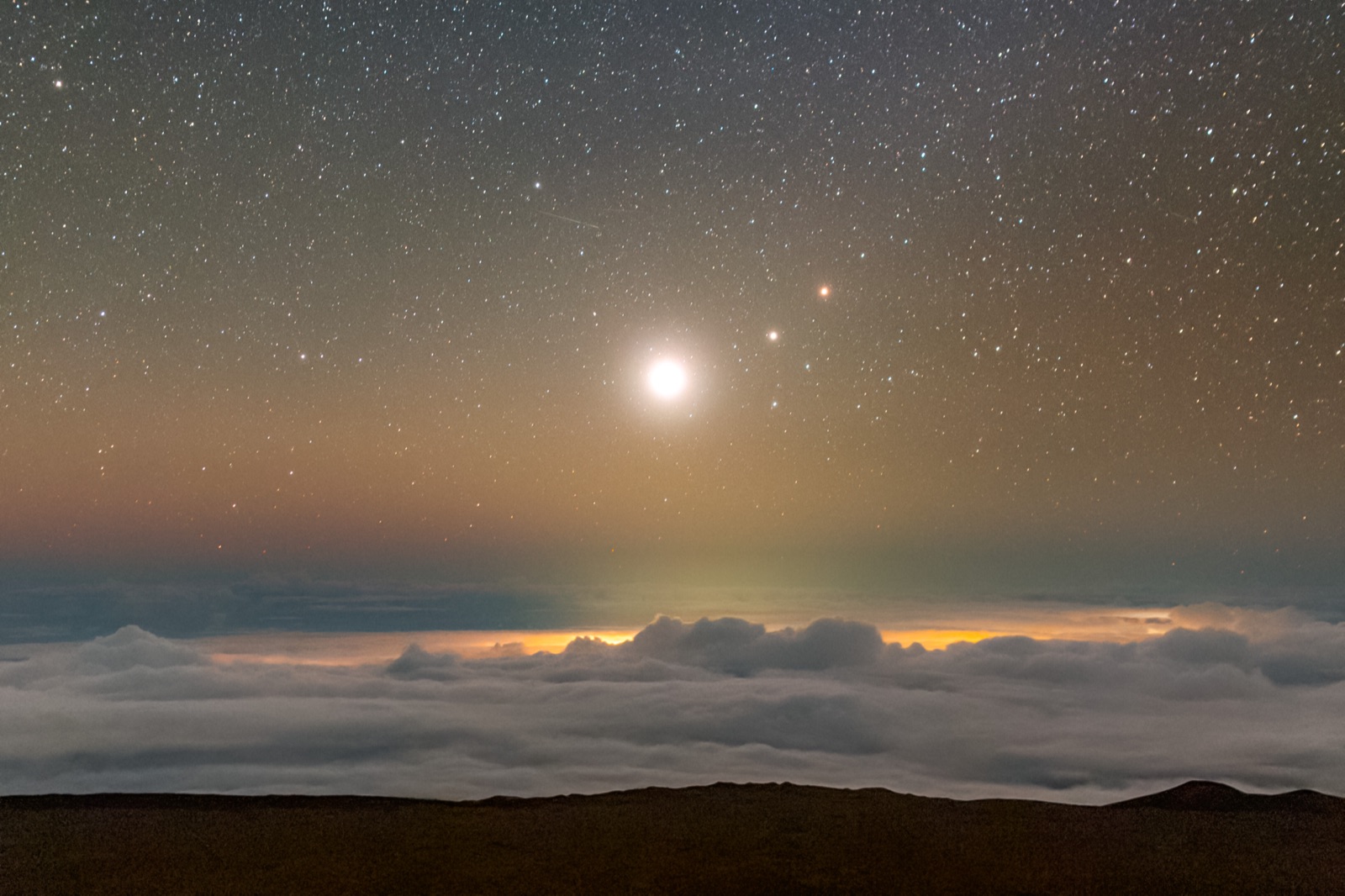
Venus is the morning star, and this is its best month. Greatest western elongation, 47° from the Sun, comes on January 3 at 19:00 UTC. Venus rises 3–4 hours before the Sun and is about 20° up in the south-east as dawn begins from mid-northern latitudes. Over the month it fades from magnitude −4.5 to −4.3 as the disc shrinks from 25″ to 19″ and the phase grows past half.
Mars sits in Leo a few degrees east of Jupiter and brightens from magnitude −0.1 on January 1 to −0.9 on the 31st, while the disc grows from 10.2″ to 13.0″. Retrograde motion begins January 10. Opposition is February 19 at −1.2 and 13.8″. It's a distant, aphelic opposition, but still the best view of Mars until 2029. It rises around 21:00 local time on January 1 and 19:00 on the 31st.
Jupiter is the brightest thing up after the Moon and Venus, magnitude −2.4 to −2.5 and 43–45″ across, in western Leo near Regulus. It rises around 20:00 local time on January 1 and 18:00 on the 31st, culminating near 02:00 mid-month, a month ahead of its February 11 opposition (which we cover in the February 2027 sky guide). Jupiter, Mars and Regulus make a triangle a few degrees wide all month.
Saturn is on its way out. It sits below the Circlet of Pisces at magnitude +0.7 to +0.8, low in the south-west at dusk, setting seven hours after the Sun on January 1 and five hours after on the 31st, around 22:00 local. The rings are only 8° open, so in a telescope the planet looks small and oval. This isn't a good year for it.
Uranus (+5.7, Taurus) is a binocular object well placed in the evening. Neptune (+7.9, Pisces, near Saturn) needs a chart.
Meteor showers: the Quadrantids
The Quadrantids are the only major shower of the month, with a ZHR of 80–120. The peak is unusually short, about six hours, so you need to be watching at the right time. Predictions for 2027 put the maximum at 04–06 UTC on January 4 (EarthSky 05:47 UTC, Astropixels 04:00). That's 05:00–07:00 in central Europe and 08:00–10:00 in western Asia, pre-dawn with the radiant high. Eastern North America gets the rising branch from about 23:00 on the 3rd with the radiant still low, and the west coast misses the peak.
The radiant is in Quadrans Muralis, a constellation that's no longer used, between the Big Dipper's handle and the head of Draco. It's low in the evening and only gets high enough after 02:00 local time. That and the January weather are why so few people have seen this shower at its best. The parent body is asteroid 2003 EH1, probably an extinct comet.
The Moon won't interfere. The waning crescent, about 13% lit, rises around 05:00 local time and is too thin to matter. From the Southern Hemisphere the radiant barely rises. No other notable shower peaks in January. The next one is the Lyrids in April.
Conjunctions and close approaches
- Jan 3 and 4, morning: Moon and Venus, 8.5°. It's a wide pair, but it photographs well. On the 3rd the crescent is above Venus, and on the 4th it's below-left of it, next to Antares. 50–85 mm, 60–90 minutes before sunrise.
- Jan 14, evening: Moon and Saturn, 6°. A five-day crescent with earthshine, with Saturn to its left, low in the south-west after dusk. 85–135 mm.
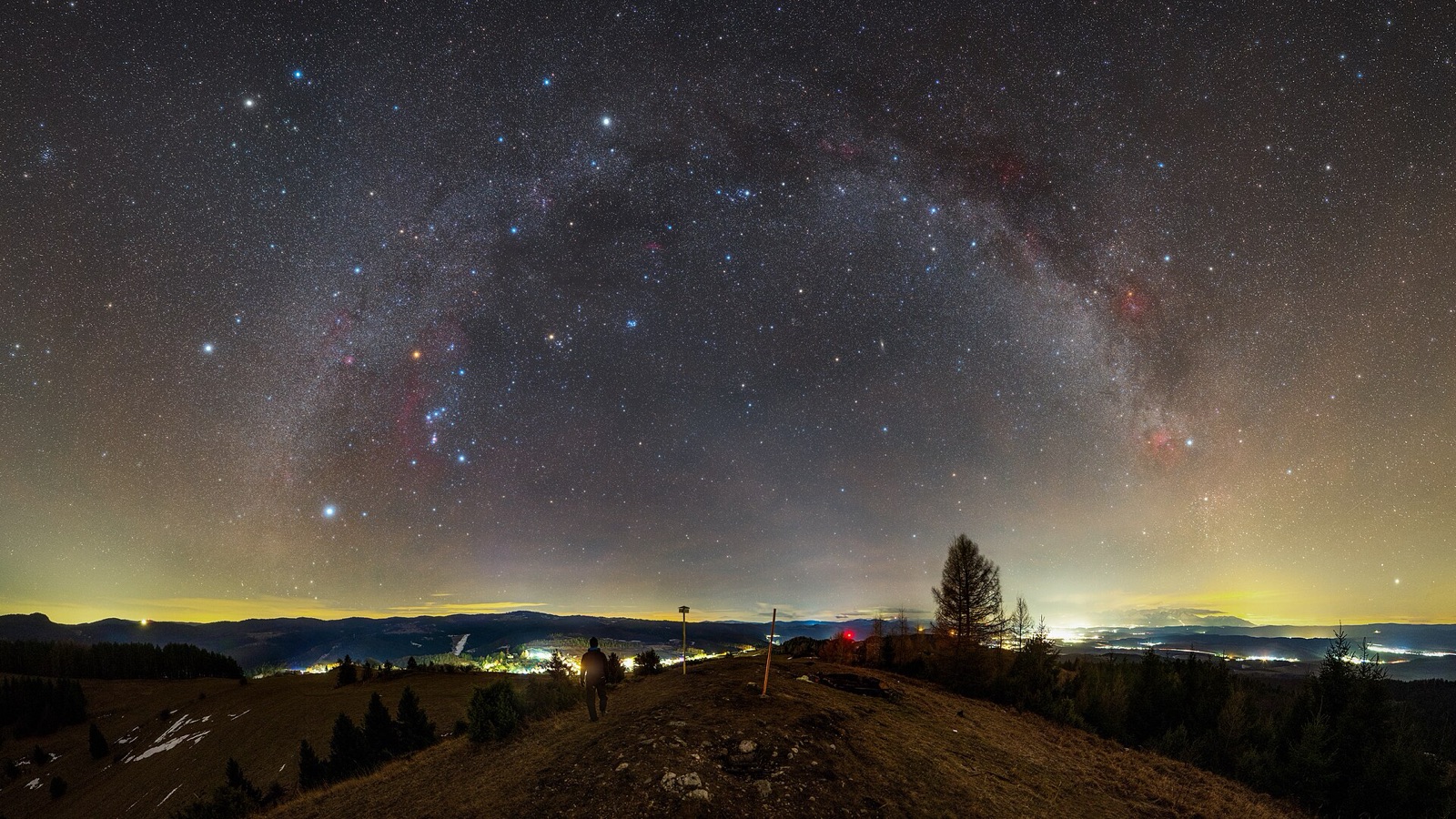
- Jan 23–24, all night: Moon, Jupiter (1.5°) and Regulus (1.5°), with Mars 6° away. The brightest grouping of the month, from moonrise around 19:00 local time until dawn. Jupiter is closest at 00:24 UTC. 100–200 mm frames Moon, Jupiter and Regulus, and 50 mm takes in Mars as well.
.jpg)
Separations are geocentric, and parallax shifts them by up to a degree depending on where you stand. The conjunction guide covers exposure. The Moon is thousands of times brighter than a planet, so bracket or blend.
Constellations and deep sky
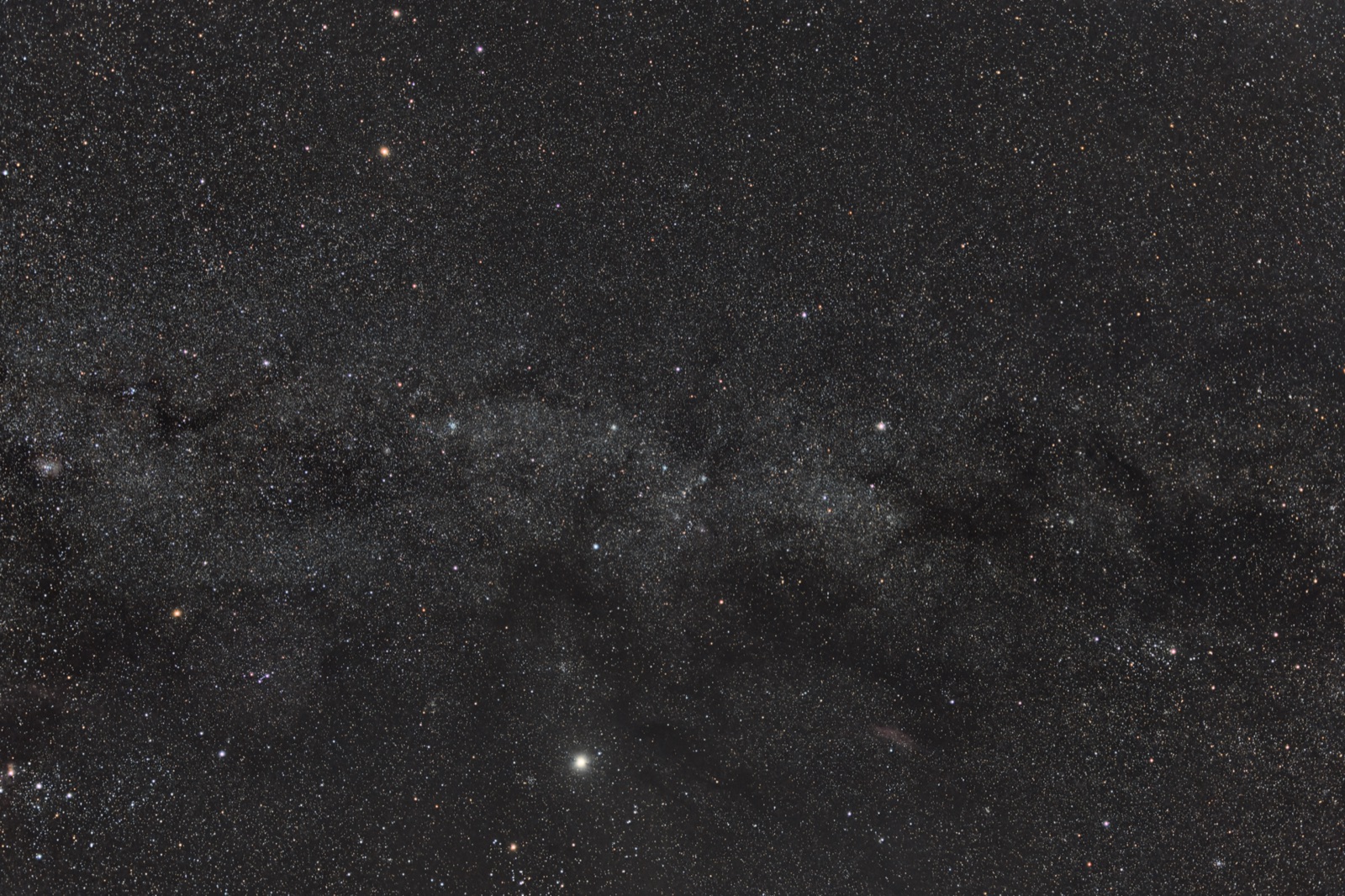
Apart from the planets, what's in the sky in January 2027 is the winter sky, and this is the best month for it. At 22:00 local time mid-month from mid-northern latitudes Orion is due south. The Orion Nebula (M42) is easy in binoculars and is the best nebula of the year for a 135–200 mm lens. Sirius, at magnitude −1.5 the brightest star in the sky, is 20° below-left of the belt. The Winter Hexagon (Sirius, Procyon, Pollux, Capella, Aldebaran and Rigel) spans 60° and needs a 14–20 mm lens on full frame. The Pleiades are high in the south-west. In the east, the Beehive (M44) in Cancer is a good binocular cluster between Pollux and Jupiter.
.png)
The Milky Way's core isn't visible this month from the north (it returns to the pre-dawn sky in March), but the winter Milky Way is. It's a fainter band from Cassiopeia through Auriga, Gemini and Orion to Canis Major. Shoot it from a dark site in the January 2–12 window around 21:00–23:00, and give it a longer exposure than you'd think. For high-latitude readers this is the best part of aurora season because the nights are so long. The aurora guide has the Kp thresholds and settings.
Southern Hemisphere: Orion is overhead and upside down, and Canopus and the Large Magellanic Cloud are high in the south. The Quadrantids are out of reach, but Venus, Jupiter and Mars are all well placed.
Sun and twilight
Evenings slowly get longer. In New York the Sun sets at 4:39 pm on January 1 and 5:12 pm on January 31, and sunrise moves from 7:20 to 7:07 am. Astronomical night runs from 6:17 pm to 5:41 am on the 1st, which is 11 h 24 min of fully dark sky. On the 31st it's 10 h 47 min. In London sunset moves from 16:02 to 16:48 and sunrise from 08:06 to 07:41. No clocks change this month. The US goes forward on March 14 and the EU on March 28.
ISS passes come in evening or morning runs of a week or two. Which you get in January depends on where you are, so check Sky Events → Satellites.
What to photograph in January 2027
- The Quadrantids, night of January 3–4. Wide lens, f/2.8, 10–20 s, ISO 3200, continuous from about 01:00 local until dawn, aimed 40–60° from the radiant. The meteor shower guide has the stacking workflow. Dress warmly, because this is the coldest shower of the year to sit through.
- The Wolf Moon rising, January 22. The year's closest full Moon rises shortly after sunset while the sky is still blue. Put it behind a landmark with a 300–600 mm lens. The Moon-behind-a-landmark guide covers the geometry and the supermoon guide covers the exposure.
- Venus and the crescent Moon, mornings of January 3–4. 35–85 mm, 1–4 s at f/4, ISO 400–800 in nautical twilight, with a south-east horizon in the foreground. The Venus guide covers its half-phase through a telephoto. If the mornings are cloudy, shoot the Moon–Jupiter–Mars grouping on the 23rd–24th instead (see the planets guide).
Everything on this page appears in Sky Events for your own location and time zone: phases, the Quadrantid peak, Venus's elongation, each Moon–planet pairing with its separation, satellite passes, with a reminder on each. The 360° sky lets you drag the time to the night of January 23 and check how high Jupiter, Mars and the Moon will be over your horizon.
FAQ
When is the full Moon in January 2027?
Friday January 22, 2027 at 12:17 UTC (7:17 am EST). It's the Wolf Moon and the closest full Moon of the year, 222,230 miles and 14 hours after perigee, so a supermoon by any definition. It looks full on the nights of both the 21st and the 22nd.
Is there a meteor shower in January 2027?
Yes, the Quadrantids, peaking around 04–06 UTC on January 4 with rates up to 120 an hour under a dark sky. The six-hour peak favours Europe and western Asia, and the thin waning crescent doesn't interfere. Watch in the hours before dawn on January 4 from a dark site.
Which planets are visible in January 2027?
Venus before dawn in the south-east, at greatest elongation on January 3. Jupiter (−2.5) and Mars (−0.1 to −0.9) together in Leo, rising in the evening and up all night. Saturn low in the south-west after dusk, setting by about 22:00. Mercury appears very low in evening twilight in the last week.
Sources and further reading
- Fred Espenak, Astropixels — Astronomical Almanac 2027 (GMT) (Moon phases, perigee/apogee, Venus and Mercury elongations, perihelion, Moon–Jupiter, Pleiades and Regulus conjunctions).
- EarthSky — 2027 Quadrantid meteor shower has narrow peak on January 3–4 (peak time, six-hour window, radiant, parent body, Moon).
- timeanddate — Sunrise and sunset times in New York, January 2027 (sunrise, sunset, twilight, perihelion time).
- NASA JPL — Horizons ephemeris system (planet magnitudes, disc sizes, elongations and constellations; rise and set times; Moon and Earth–Sun distances; Moon–planet separations; Saturn ring tilt).
- ALPO, Jeffrey Beish — The 2026–2027 aphelic apparition of Mars (opposition time, 13.8″ disc, closest approach, retrograde from January 10).
- Sea and Sky — Astronomy Calendar of Celestial Events 2027 (cross-check of phases, supermoons, elongations and the February oppositions).