Sky calendar
What's in the Sky in November 2026: Moon, Planets, Meteors and What to Photograph
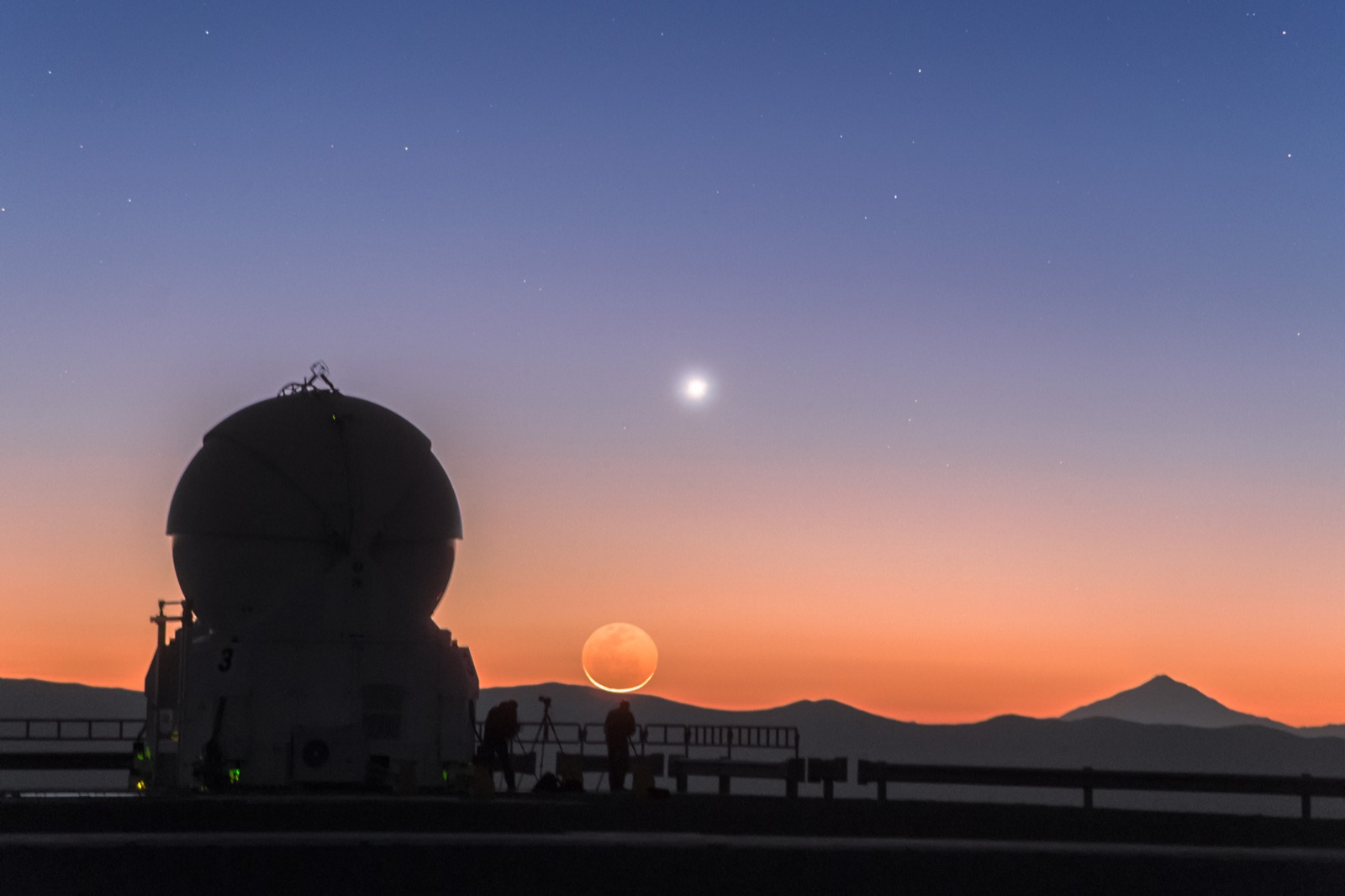
Most of what's in the sky in November 2026 happens before dawn. The waning Moon occults Mars and then Jupiter on Nov 2, nine hours apart. An old crescent stands 1° from a newly returned Venus on Nov 7, Mars and Jupiter pass 1.2° apart on Nov 15–16, and Venus reaches greatest brilliancy at month's end. There's plenty in the evening too. Saturn is a month past opposition, Uranus reaches opposition on Nov 25 beside the Pleiades, and Orion is up by 10 pm. The Moon is new on Nov 9 and full on Nov 24, the Beaver Moon. The one we'd photograph is the Nov 7 crescent and Venus over a landmark. Times are UTC unless stated, so convert to your local time.
At a glance
- Nov 2: the last-quarter Moon occults Mars (14:23) and Jupiter (23:11). Close pairings everywhere, occultations for the Pacific, Australia and southern Asia.
- Nov 7: a 25-hour-old crescent 1.1° from Venus before dawn.
- Nov 15–16: Mars 1.2° north of Jupiter in Leo, in the morning sky.
- Nov 17–18: Leonids peak at 00:00 on Nov 18 (ZHR 10–15), and the first-quarter Moon sets around midnight.
- Nov 24: full Beaver Moon at 14:53, 224,171 miles away. Uranus is at opposition on Nov 25.
What's in the sky in November 2026, date by date
| Date (UTC) | Event | How to see it |
|---|---|---|
| Nov 1 | US clocks back 1 hour at 2:00 am local. Last quarter Moon 20:28 | Sunset an hour earlier in the US. The Moon rises around midnight. |
| Nov 2, 14:23 | Mars 1.1° N of Moon, occultation | Occultation from French Polynesia, the Cook Islands and Pitcairn. A close pairing elsewhere. |
| Nov 2, 23:11 | Jupiter 0.5° N of Moon, occultation | Occultation from Australia, Indonesia, Malaysia and southern India (their morning of Nov 3). |
| Nov 4 | Mercury at inferior conjunction | Not visible. Moves into the morning sky. |
| Nov 5, 00:22 | Southern Taurids peak | ZHR ~5, slow fireballs. No Moon after midnight. |
| Nov 7, 11:31 | Venus 1.1° N of Moon, occultation | Occultation over the south-east Pacific. Crescent beside Venus before dawn everywhere. |
| Nov 9, 07:02 | New Moon | Centre of the dark window, Nov 4–14. |
| Nov 10, 13:49 | Venus 0.1° S of Spica | Dawn, east-south-east. Use binoculars. |
| Nov 12 | Northern Taurids peak | ZHR ~5. Thin crescent sets early. |
| Nov 16, 04:00 | Mars 1.2° N of Jupiter | High in the south-east before dawn, in Leo. |
| Nov 17, 11:48 | First quarter Moon | Sets around local midnight. |
| Nov 18, 00:00 | Leonids peak | ZHR 10–15. Watch from moonset to dawn. |
| Nov 20, 23:00 | Mercury at greatest elongation west, 19.6° | Magnitude −0.5, low in the east-south-east 45 minutes before sunrise. |
| Nov 24, 14:53 | Full Moon (Beaver Moon), 224,171 mi | Rises near sunset. Supermoon by the 90% rule. Passes 0.9° from the Pleiades at 11:18. |
| Nov 25, 20:58 | Moon at perigee, 223,288 mi | Large tides. |
| Nov 25, 23:00 | Uranus at opposition, magnitude +5.6 | All night in Taurus, about 4° from the Pleiades. Use binoculars. |
| Nov 30, 09:18 | Jupiter 1.2° N of Moon, occultation | Second Moon–Jupiter occultation of the month. A close pairing for most. |
November 2026 full Moon and the dark window
Last quarter Nov 1 (20:28), new Nov 9 (07:02), first quarter Nov 17 (11:48), full Nov 24 (14:53), last quarter again Dec 1 (06:09). The Beaver Moon, at 224,171 miles, counts as a supermoon under the common rule (full within 90% of perigee). It's the smallest of the three in the 2026–27 run, though, and some sources only use the label for December's 221,668-mile Cold Moon. It will look big on the horizon either way. Perigee follows on Nov 25 at 20:58. From mid-northern latitudes it rises within half an hour of sunset on Nov 24 and stays high all night.
The dark window runs from about Nov 4 to Nov 14. The waning crescent rises after 3 am on the 4th and is gone by the 8th. The waxing crescent sets by about 9 pm until the 14th. Evenings stay Moon-free until about the 16th, and from the 21st the Moon is up all night.
The Sun & Moon card gives moonrise, moonset, phase, % illuminated and distance for your spot on any date, so you can check which nights the Moon is down before astronomical twilight ends. Moon Details counts down to the Nov 24 full Moon.
Planets visible in November 2026
Mercury is at inferior conjunction on Nov 4, then climbs into the dawn for a good morning apparition in the north, with greatest elongation west on Nov 20 (19.6°, magnitude −0.5). Look low in the east-south-east 30–45 minutes before sunrise from about Nov 14, below Venus, which helps you find it.
Venus passed inferior conjunction on Oct 24 and returns to the morning sky quickly. By Nov 7 it's about 10° up at sunrise and shows a thin crescent in a telescope. It passes 0.1° from Spica on Nov 10 and reaches greatest brilliancy on Nov 27–29 (sources differ on the definition) at about magnitude −4.7, rising three hours before the Sun. It stays a morning star until June 2027.
Mars, at about magnitude +0.7 in Leo, rises around local midnight and is 40° up by dawn. It's occulted by the Moon on Nov 2, passes 1.2° from Jupiter on Nov 15–16 and 1.6° from Regulus on Nov 25. It keeps getting brighter as it heads for its Feb 19, 2027 opposition.
Jupiter, magnitude −2.1 in Leo, also rises near midnight and stands high in the south by dawn. The Moon occults it twice this month, on Nov 2 and Nov 30. Opposition is Feb 11, 2027.
Saturn, a month past its Oct 4 opposition, is the evening planet. It's about magnitude +0.5 on the Pisces–Cetus border, due south around 9 pm mid-month, and it sets after 2 am. The rings are open only about 7°.
Uranus reaches opposition on Nov 25 at magnitude +5.6 in Taurus, about 4° from the Pleiades, where it looks like a greenish star in binoculars. Neptune (magnitude +7.8, Pisces, opposition Sep 26) is west of Saturn, and you need a chart to find it.
Meteor showers in November 2026
Taurids. The Southern Taurids peak on Nov 5 (00:22) and the Northern Taurids on about Nov 12 (Astropixels; EarthSky puts the northern peak on Nov 9). Both are weak, about five meteors an hour each, but the meteors are slow and a lot of them are fireballs, and there's almost no Moon at either peak. A weak shower with fireballs is better to photograph than the numbers suggest, because one good fireball makes the night worth it.
Leonids. Peak predicted for 00:00 on Nov 18, ZHR 10–15, and no storm is forecast. The first-quarter Moon sets around midnight local time, so watch from moonset to dawn on Nov 18 with the radiant in the Sickle of Leo high. Leonids are fast, 44 miles per second, and leave persistent trains, which are worth photographing.
The next shower is the Geminids on Dec 13–14, the best of the year, with a crescent Moon that sets in mid-evening. They're in the December 2026 sky guide.
Conjunctions and close approaches
- Nov 2–3, Moon–Mars–Jupiter–Regulus (morning). Outside the occultation tracks the Moon sits a few degrees from Mars at dawn on Nov 2, and from Jupiter and Regulus (0.8° at 08:40) on Nov 3. A 50–85 mm lens fits the whole line in one frame. Expose for the Moon's night side. The conjunction guide explains why.
- Nov 7, Moon–Venus 1.1° (morning). Closest for the Americas at dawn, 3–4° apart for Europe. Look low in the east-south-east 45 minutes before sunrise.
- Nov 10, Venus–Spica 0.1° (morning). A double star to the naked eye, split in binoculars.
- Nov 15–16, Mars–Jupiter 1.2° (morning). Closest at 04:00 on Nov 16, near the Sickle of Leo. A 200–300 mm lens shows Jupiter's moons and the colour contrast.
- Nov 24, Moon–Pleiades 0.9° around 11:18, with stars emerging from the dark limb in binoculars. Nov 30, Moon–Jupiter 1.2°, an occultation for part of the world.

Night sky this month: constellations and deep sky
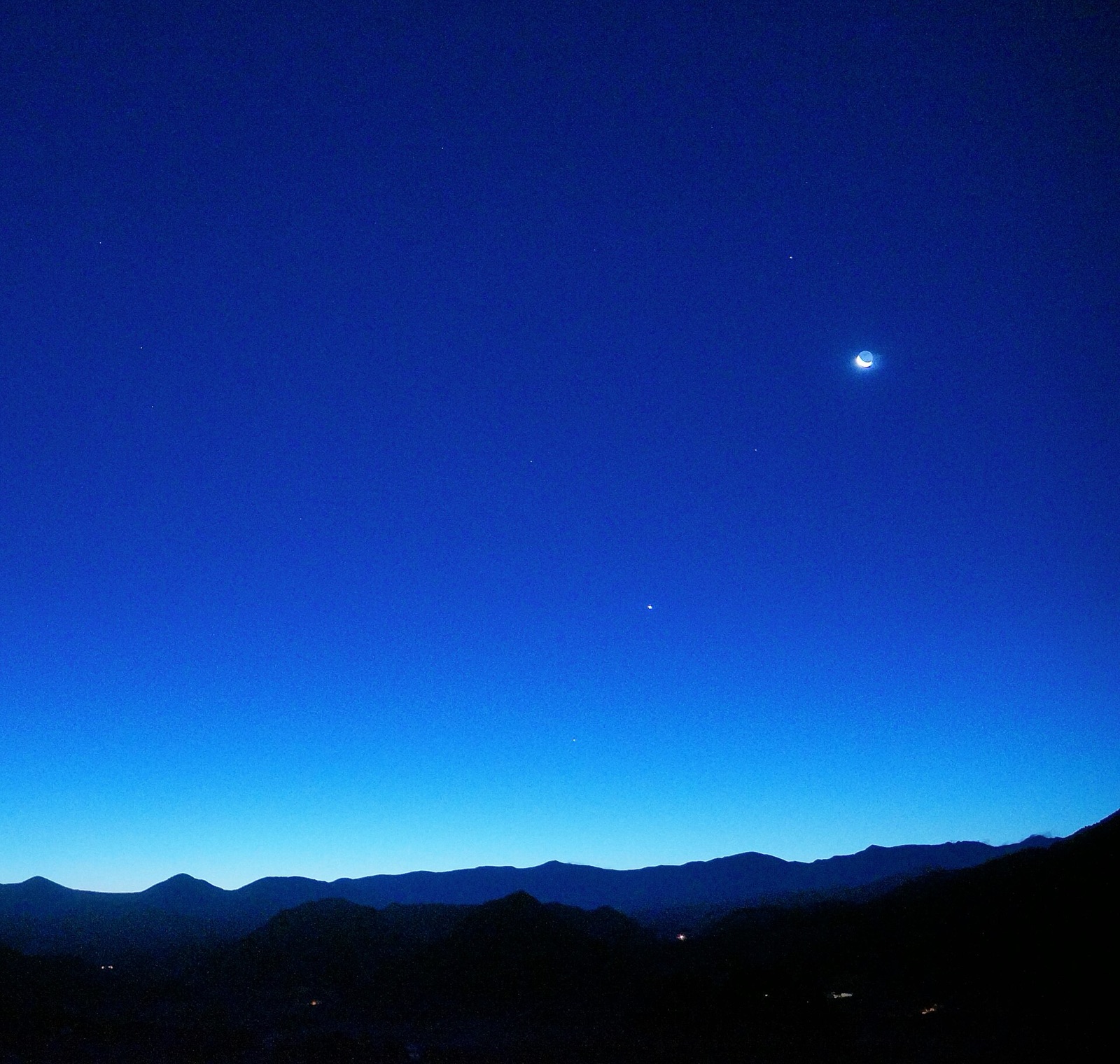
At 10 pm local time mid-month from mid-northern latitudes, the Andromeda Galaxy (M31) is almost overhead, the Square of Pegasus just west of the zenith and Cassiopeia high in the north. Perseus and the Double Cluster (NGC 869/884) are high in the north-east, the Pleiades (M45) about 50° up in the east with the Hyades below. Orion clears the eastern horizon around 9 pm, and the Orion Nebula (M42) is best after midnight.
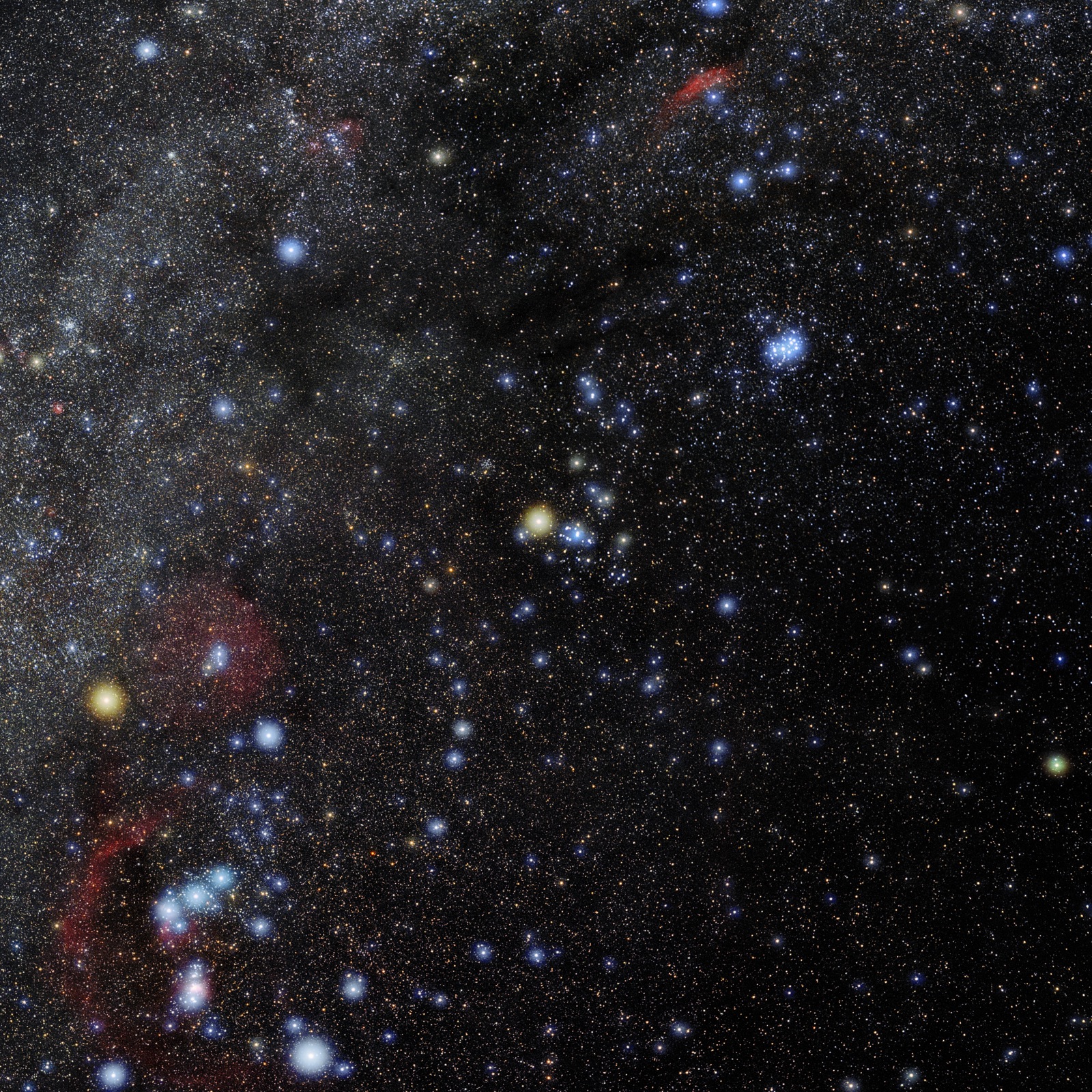
The Milky Way's core is gone from northern evenings until spring. What's left is the fainter winter arm, which runs from Cygnus in the west through Cassiopeia and Perseus overhead to Auriga and Gemini in the east. By midnight it's a low arch, good for panoramas in the Nov 4–14 dark window. It's faint, and light pollution hides it more easily than it hides the core. Southern-hemisphere observers have the Magellanic Clouds, 47 Tucanae and the Sculptor Galaxy (NGC 253) high in the evening, with Orion rising, inverted, later in the night.
Sun and twilight
The nights get longer quickly, and by the end of the month it's dark enough for deep sky early in the evening. In New York, sunset falls from 4:52 pm EST on Nov 1 (the morning the clocks go back) to 4:29 pm on Nov 30, and sunrise moves from 6:26 am to 6:59 am. In London, sunset drops from 4:33 pm on Nov 1 to 3:55 pm on Nov 30, sunrise from 6:53 am to 7:42 am. Astronomical night on Nov 15 lasts about 10 h 55 min in New York (6:12 pm to 5:08 am) and 11 h 15 min in London (6:08 pm to 5:21 am). US daylight saving time ends at 2:00 am local on Sunday Nov 1. EU clocks changed on Oct 25.
ISS passes come in runs of a week or two, evening or morning depending on location. Check Sky Events → Satellites and the ISS guide for a trail over a landmark.
What to photograph this month
These are the three nights we'd plan for.
- Nov 7, before dawn: the old Moon and Venus over a landmark. Earthshine on the crescent, Venus near magnitude −4.5, low in the east-south-east. Use the Planner to put the pair behind a tower or ridge. Bracket 1/15–1/250 s at ISO 400 with 135–300 mm. See the Venus guide and Moon behind a landmark.
- Nov 16, 3–5 am: Mars and Jupiter 1.2° apart. High in the south-east, no Moon. 200 mm at f/4, 1–2 s, ISO 800 gets the pair and the Galilean moons, and 24 mm takes in Leo and Venus rising. The method is in the planets guide.
- Nov 24, at sunset: the Beaver supermoon rising. The Moon comes up in the north-east within half an hour of sunset, in a sky that's still blue. Use 400–600 mm with a foreground 1–3 miles away, and 1/125 s, f/8, ISO 200 as it clears the horizon. The supermoon guide covers the alignment. Earlier in the month, the other option is the Leonids from moonset to dawn on Nov 18, with the meteor shower guide.
Sky Events lists every event on this page for your own location with local times, altitude and direction, and reminders: Conjunctions, Meteor Showers, Oppositions, Satellites. Open any of them in the 360° sky and drag the time forward to see where the pair will be.
FAQ
When is the full Moon in November 2026?
Tuesday Nov 24, 2026 at 14:53 UTC (9:53 am EST). It's the Beaver Moon, a supermoon by the common 90%-of-perigee rule at 224,171 miles. New Moon is Nov 9 at 07:02 UTC.
Is there a meteor shower in November 2026?
Three, all weak. The Southern Taurids peak on Nov 5 and the Northern Taurids around Nov 12, about five slow meteors an hour each, many of them fireballs, with no Moon in the way. The Leonids peak at 00:00 UTC on Nov 18 with 10–15 an hour. Watch from moonset (around midnight) to dawn.
Which planets are visible in November 2026?
Saturn in the evening, due south by 9 pm. Jupiter and Mars rise around midnight and are high before dawn, 1.2° apart on Nov 15–16. Venus is low in the dawn from the first week and brightest at month's end, with Mercury below it from mid-month. Uranus is at opposition on Nov 25 in Taurus, in binoculars all night.
Sources and further reading
- Fred Espenak, Astropixels — Astronomical Almanac 2026 (GMT) (Moon phases, perigee/apogee, conjunctions, occultations, elongations, opposition and shower dates).
- timeanddate — Moon phases 2026, UTC, Sun in New York, November 2026, Sun in London, November 2026, DST 2026 in the United States.
- EarthSky — Uranus at opposition on November 25, 2026, Leonid meteor shower 2026, Taurid meteors in 2026, Saturn at opposition on October 4, Venus greatest brilliancy (magnitudes, ZHR, Moon interference, ring tilt, Nov 29 brilliancy).
- In-The-Sky.org — Lunar occultation of Mars, Nov 2, Lunar occultation of Jupiter, Nov 2, Conjunction of Jupiter and Mars, Nov 15, Venus at greatest brightness, Nov 27 (visibility zones, separations, magnitudes).
- Farmers' Almanac — Beaver Moon 2026 (full Moon name and 360,768 km distance).